9K vs 14K Gold: What's the Difference and Which Is Better?
When you are standing between two pieces of gold jewellery and trying to decide which karat is right for you, the numbers printed on the hallmark tell only part of the story. 9K and 14K gold are both real, beautiful, UK-hallmarked gold. But they behave differently on the wrist, look different against the skin, wear differently over time, and suit different buyers in distinctly different ways.
For buyers comparing the difference between 9K and 14K gold, the most important factors are durability, colour, price, and how the piece will actually be worn.
This guide covers everything you need: colour, durability, price, skin sensitivity, and the specific jewellery types each karat genuinely suits. By the end, the difference between 9K and 14K gold will be clear, and the right choice for your life will be obvious.
Quick Answer: Choose 9K gold if you want the hardest, most affordable option for everyday rings and bracelets. Choose 14K gold if you want a richer colour, slightly lower alloy exposure, and a more luxurious middle ground.
9K vs 14K Gold at a Glance
What Are 9K and 14K Gold? Composition Explained
Before comparing the two, it helps to understand what each karat actually means in the metal on your wrist.
9K gold contains 37.5% pure gold, with the remaining 62.5% made up of alloying metals including silver, copper, zinc, and palladium. In the United Kingdom, 9K is the minimum legal standard for gold jewellery, fully hallmarked and regulated by the UK Assay Office. It is the most widely purchased gold standard in Britain, and for good reason.
14K gold contains 58.3% pure gold, with 41.7% alloying metals. It sits between 9K and 18K as a considered middle ground, offering a richer colour than 9K while still maintaining meaningful durability advantages over higher karat options.
Both are real gold. Both are UK hallmarked. Both will last a lifetime with proper care. The question is not which one is genuine, but which one is right for your life.
The alloying metals in both compositions serve a specific purpose: they strengthen the gold, give it the hardness needed to hold settings securely, and contribute to the warmth or coolness of the metal's final colour. Explore our 9K gold jewellery collection and 14K gold jewellery collection to see how both karats translate into finished pieces.
Is There a Visible Difference Between 9K and 14K Gold?
This is one of the most common questions buyers ask, and the answer is: yes, there is a visible difference, but it is more nuanced than most guides suggest.
If you want a deeper breakdown of how each gold colour behaves across different karats, read our complete guide to white gold vs yellow gold vs rose gold.
Yellow Gold
9K yellow gold has a lighter, slightly paler golden tone. It reads as warm and golden, but without the depth and saturation of higher karat pieces. Some buyers prefer this precisely: it is a contemporary, understated gold that sits easily alongside silver tones and does not compete with gemstone colour.
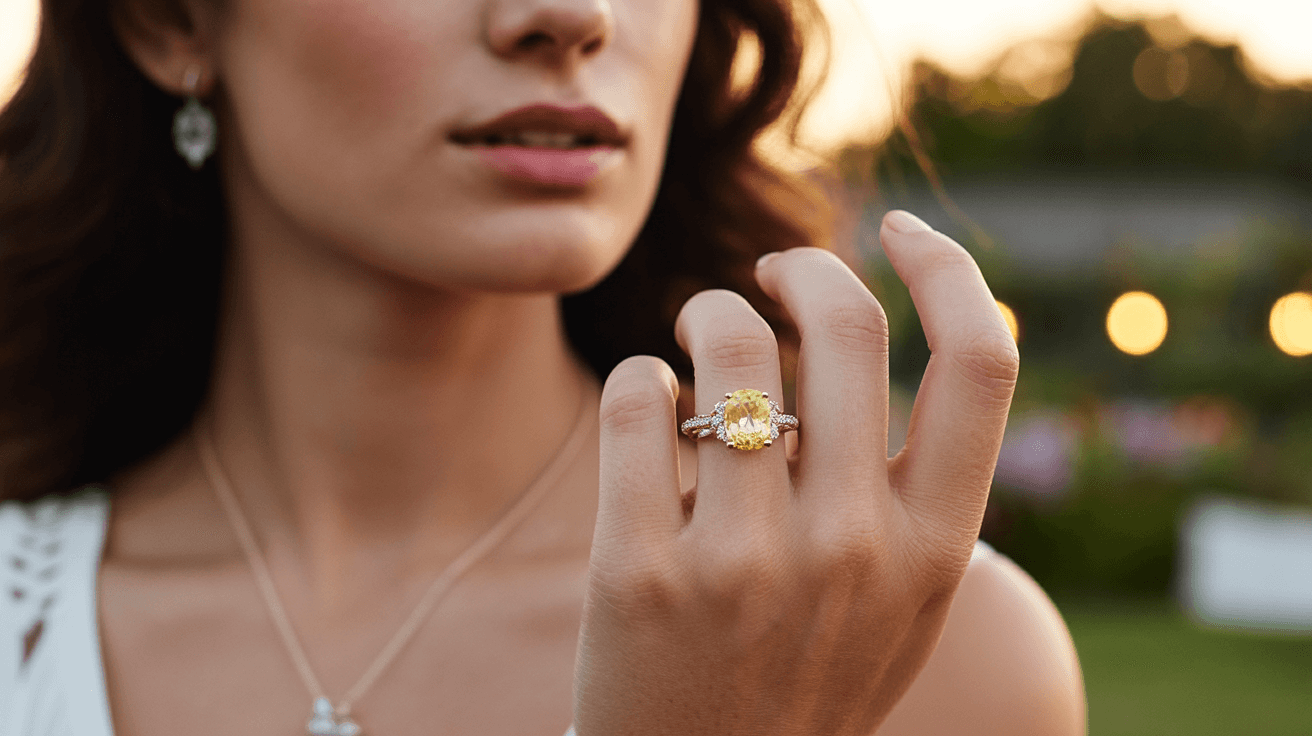
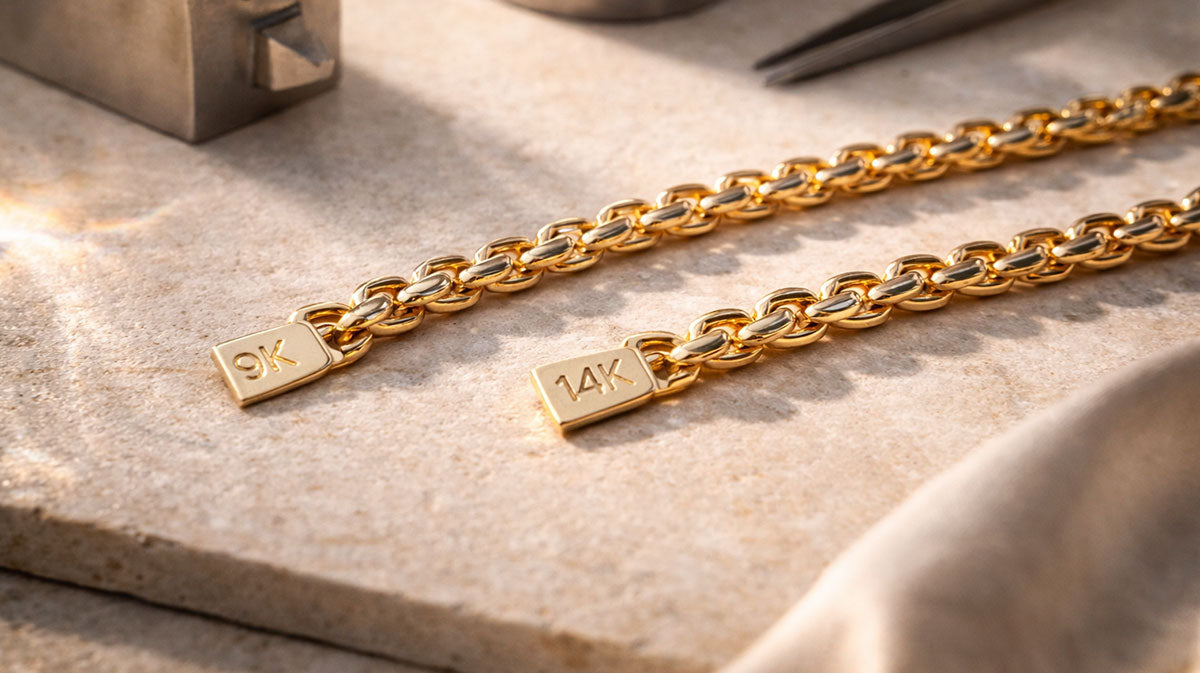
14K yellow gold is noticeably richer. The higher gold content produces a deeper, more traditional golden hue that reads as unambiguously luxurious. Side by side with a 9K piece under good lighting, the difference is clear. The 14K piece will usually read as warmer and more saturated across most lighting conditions.

White Gold
Both 9K and 14K white gold are rhodium-plated as standard, which means they look virtually identical when new: bright, platinum-like, and crisp. The difference reveals itself as the plating wears down over time.
9K white gold, with its higher proportion of whitening alloy metals, maintains its pale tone more readily as the rhodium fades. 14K white gold beneath the plating can reveal a slightly warmer, more cream-toned base. Both require periodic rhodium re-plating, but 9K white gold typically extends the interval between maintenance appointments.

Rose Gold
The rose gold comparison is the most visually interesting. 9K rose gold tends towards a more pronounced, pinker blush, because the higher alloy content means more copper in the mix. 14K rose gold is subtler, a warmer champagne-rose that many find more versatile and easier to combine with other metals and gemstones.
For buyers who want rose gold that announces itself clearly, 9K is the bolder choice. For those drawn to a more restrained warmth, 14K strikes a more refined note.

Durability and Scratch Resistance: The Critical Comparison
This is where 9K gold holds its clearest practical advantage, and it is an advantage that matters enormously for jewellery worn every day.
The relationship between karat and hardness is direct: the more pure gold in the alloy, the softer the resulting metal. Pure gold is famously soft, which is why it is always alloyed with strengthening metals for jewellery use. The higher the karat, the more of that inherent softness carries through into the finished piece.
On the Mohs hardness scale:
- 9K gold rates approximately 3.5 to 4
- 14K gold rates approximately 3 to 3.5
- 18K gold rates approximately 2.5 to 3
For a deeper comparison of how higher karats behave in terms of colour, durability, and long-term value, see our 14K vs 18K gold comparison guide.
In real terms, a 9K gold ring worn daily will resist scratching more effectively than a 14K equivalent under identical conditions. That difference compounds over months and years of consistent wear. For pieces that live on the hand or wrist through every activity, that gap in hardness is not trivial.
Beyond surface scratch resistance, the structural strength of the metal affects how well settings hold gemstones over time, how prongs maintain their shape under pressure, and how chain links withstand the constant tension of daily movement.
9K gold's higher alloy content provides superior structural integrity for:
- Prong settings holding precious gemstones securely over the years of wear
- Fine chain links that flex continuously without fatiguing
- Clasps and findings are subject to repeated mechanical stress
- Rings worn actively where deformation under pressure is a real risk
14K gold offers entirely adequate structural strength for most jewellery applications. The difference becomes meaningful primarily for pieces subjected to the most demanding daily conditions, which, for most people, means rings on the dominant hand.
Skin Sensitivity and Allergic Reactions
For buyers with sensitive skin, the karat choice can make a practical difference, though perhaps not in the way most people assume.
Gold itself is hypoallergenic. It is the alloying metals, particularly nickel, copper, and certain zinc compounds, that trigger reactions in susceptible individuals. The higher the gold content, the lower the proportion of potentially reactive metals in the alloy.
14K gold, with 58.3% pure gold, contains proportionally fewer reactive alloying metals than 9K. For those with known metal sensitivities, the lower allergen exposure of 14K can make a meaningful difference, particularly in pieces worn in prolonged contact with the skin.
9K gold contains a higher proportion of alloying metals by definition. However, reputable jewellers, including Juvetti, use nickel-free alloy formulations designed specifically for sensitive skin. The use of palladium and silver as primary alloying metals in place of nickel significantly reduces the risk of reaction, even at lower karat levels.
If you have experienced reactions to gold jewellery previously, identifying the specific metal responsible is far more useful than simply upgrading to a higher karat. Reactions to 9K jewellery are most commonly caused by nickel, which is entirely avoidable regardless of karat through careful alloy selection.

Price Difference: What to Expect
The price difference between 9K and 14K gold is meaningful, and it compounds as the size and complexity of a piece increase.
9K gold is significantly more affordable per gram than 14K, because it contains less pure gold by weight. For larger pieces such as tennis bracelets, statement necklaces, or substantial rings, this difference can represent a considerable saving that allows for either a larger design within the same budget, or the same design with higher quality gemstones.
As a practical framework for UK buyers:
- A standard 9K gold chain necklace might cost 30 to 45% less than an equivalent 14K piece of the same weight
- The gap widens with heavier pieces and narrows with more design-intensive items, where craftsmanship rather than metal weight drives the price
- Both hold intrinsic value as real gold, though 14K's higher gold content means the metal value within each piece is proportionally greater
If you are considering gold from an investment perspective as well as a jewellery purchase, our guide to whether gold jewellery is a good investment explains what actually holds value over time.
For buyers building a jewellery collection across multiple pieces, choosing 9K for everyday workhorses and 14K for more significant pieces is a genuinely intelligent allocation of budget. You are not compromising on quality by choosing 9K for a daily wear ring. You are choosing the karat that is best suited to that ring's purpose.
Which Is Better for Everyday Wear?
For many everyday wear applications, 9K gold is often the more practical choice because of its higher hardness and lower cost. This is most true for rings and bracelets, where contact and friction are unavoidable parts of daily life.
A ring on the dominant hand makes contact with surfaces hundreds of times each day. Under those conditions, the harder alloy of 9K gold holds its surface quality longer, maintains prong integrity more reliably, and shows the accumulated wear of daily life less visibly than softer alternatives.
For necklaces and earrings, where contact and friction are considerably less aggressive, the practical advantage of 9K narrows significantly. A 14K necklace worn daily will perform beautifully over many years, and its richer colour may well be worth the modest premium for a piece worn close to the face.
The question to ask yourself is a simple one: how does this specific piece live in your life? A ring worn through cooking, cleaning, and physical work calls for different priorities than a pendant worn beneath a shirt that you rarely touch.

9K vs 14K Gold by Jewellery Type
Rings
For everyday rings, particularly those worn on the dominant hand, 9K gold is often the more practical choice for many buyers. The hardness advantage is most meaningful here, and the price difference is most pronounced in a category where heavier metal weights are common. For pieces worn continuously through active daily life, 9K gold maintains its appearance more reliably under daily friction.
14K is an excellent choice for rings worn less frequently, special occasion pieces, or where the richer colour matters aesthetically. Both are entirely suitable for gemstone settings. Explore our 14K gold jewellery collection for ring designs that balance colour richness with reliable everyday performance.
Necklaces
For daily wear necklaces, both karats perform well. 14K gold's richer colour is particularly appealing in necklaces and pendants, where the warmth of the metal contributes significantly to the overall aesthetic. The durability advantage of 9K matters less in necklaces, which face considerably less contact than rings and bracelets.
For heavier chain styles or layered necklace arrangements, 9K's price advantage allows for more substantial designs within the same budget. Browse our 9K gold jewellery collection for chain and pendant styles that deliver maximum presence at an accessible price.
Bracelets
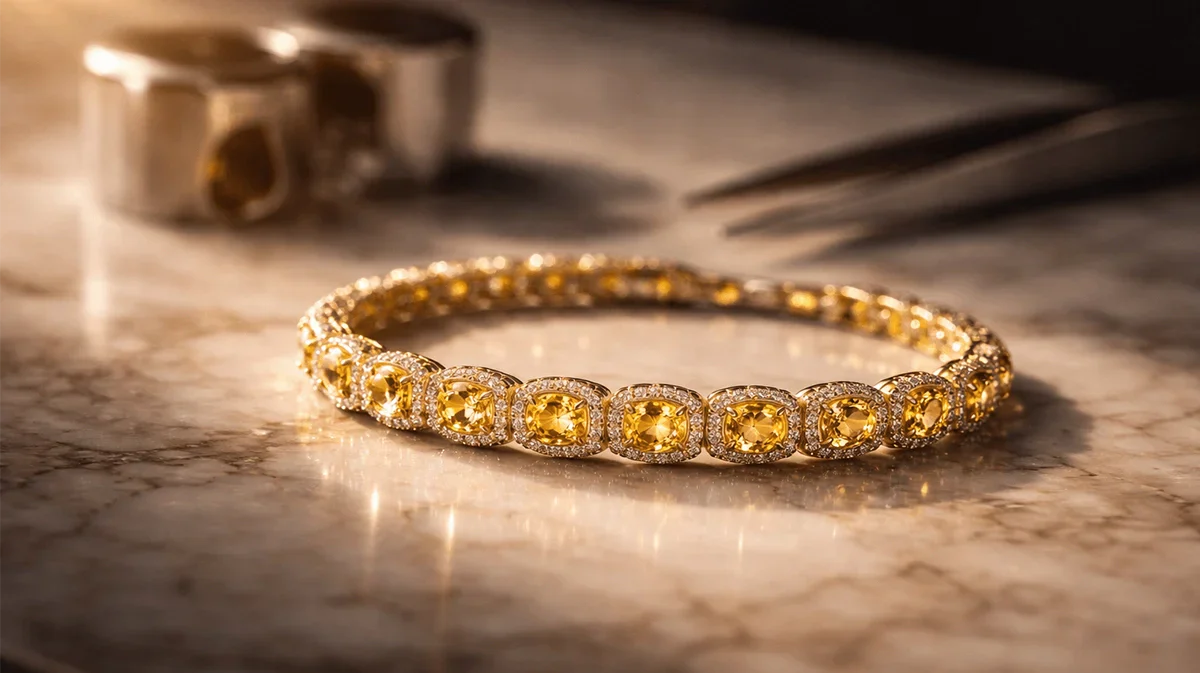
Bracelets occupy a middle ground. They face more daily contact than necklaces but generally less friction than rings. For active wearers, tennis bracelets, and pieces worn without removal, 9K gold's hardness is a genuine practical advantage. For bangles and occasional-wear styles, 14K's colour richness may tip the balance.
Earrings
For earrings, particularly studs and sleepers worn continuously, 14K gold's lower allergen profile and richer colour both argue in its favour. Earrings experience less surface friction than other jewellery types, which reduces the practical significance of 9K's hardness advantage. Where skin sensitivity is a concern, 14K's higher gold content provides additional reassurance.
Who Should Choose 9K, and Who Should Choose 14K?
Choose 9K gold if you:
- Wear your rings and bracelets constantly through active daily life
- Are building a collection across multiple pieces and want to distribute the budget intelligently
- Want the most durable option for pieces worn in demanding conditions
- Prefer a lighter, more contemporary gold tone
- Are you making your first investment in real, UK hallmarked gold
- Want a larger or more elaborate design within a specific budget
Choose 14K gold if you:
- Want a noticeably richer, more traditional golden colour
- Have known sensitivities to alloying metals and want a higher gold content for reassurance
- Are choosing a piece for special occasions or milestone gifting
- Are you selecting earrings or necklaces where the durability gap matters less
- Want a middle ground between the accessibility of 9K and the luxury of 18K
- Are considering a piece with investment or heirloom intent

Making Your Decision
The most useful framework for choosing between 9K and 14K gold is not a quality hierarchy. It is a purpose hierarchy.
9K gold is especially well suited to jewellery that lives an active life on the body: the ring that never comes off, the bracelet worn through everything, the everyday chain that is as much a part of getting dressed as the clothes themselves. It is harder, more affordable, and entirely suited to that purpose.
14K gold is especially appealing for jewellery where the richness of colour, the elevated gold content, and the subtler allergen profile all justify the premium. It is not fragile by any measure. It simply rewards a slightly more considered wearing intention.
Neither choice is wrong. Both are real gold. Both are UK hallmarked. Both will be beautiful for a lifetime. The question is simply which one fits the piece, the purpose, and the person wearing it.
Explore our complete gold jewellery range across 9K Gold, 14K Gold, and 18K Gold to find the karat that belongs in your collection.
Frequently Asked Questions
Is 9K gold better than 14K?
Neither is universally better. 9K gold is harder and more scratch-resistant, making it a strong choice for daily wear pieces like rings and bracelets. 14K gold offers a richer colour and slightly lower allergen profile, making it better suited to special occasion pieces, earrings, and necklaces. The right choice depends entirely on the jewellery's purpose and your wearing habits.
What is the difference between 9K and 14K gold?
The main difference is gold content. 9K gold contains 37.5% pure gold; 14K contains 58.3%. This affects colour, hardness, price, and allergen exposure. 9K is harder and more affordable. 14K is richer in colour and contains proportionally fewer alloying metals.
Is 9K or 14K gold better for everyday wear?
For rings and bracelets worn through active daily life, 9K gold's greater hardness makes it the more practical choice for many buyers. For necklaces and earrings worn in less demanding conditions, 14K's richer colour and lower alloy content can make it the more appealing option.
Is 9K gold real gold?
Yes, absolutely. 9K gold contains 37.5% pure gold, is UK hallmarked and regulated by the UK Assay Office, and is solid gold throughout. It is not gold-plated or gold-filled. It is the most widely purchased gold standard in the United Kingdom.
Is there a visible difference between 9K and 14K gold?
Yes. 14K gold has a noticeably richer, deeper golden colour than 9K, particularly in yellow gold. The difference is most apparent when pieces are placed side by side under good lighting. In white gold, both look identical when rhodium-plated and the difference only becomes visible as the plating wears. In rose gold, 9K reads as a stronger blush and 14K as a subtler, warmer rose.
Which is better for sensitive skin, 9K or 14K gold?
14K gold contains a higher proportion of pure gold and proportionally fewer alloying metals, which generally reduces allergen exposure. However, the specific alloy composition matters more than the karat itself. Nickel-free 9K formulations from quality jewellers are entirely suitable for most sensitive skin types.
Does 9K gold tarnish?
9K gold does not tarnish like silver, but its higher alloy content means it can develop a subtle surface dullness over time due to the oxidation of non-gold metals. This is easily resolved with regular gentle cleaning and occasional professional polishing.