Lab Grown Diamond Tennis Bracelet: A Complete Buying Guide
One design, and a range inside it that surprises most people.
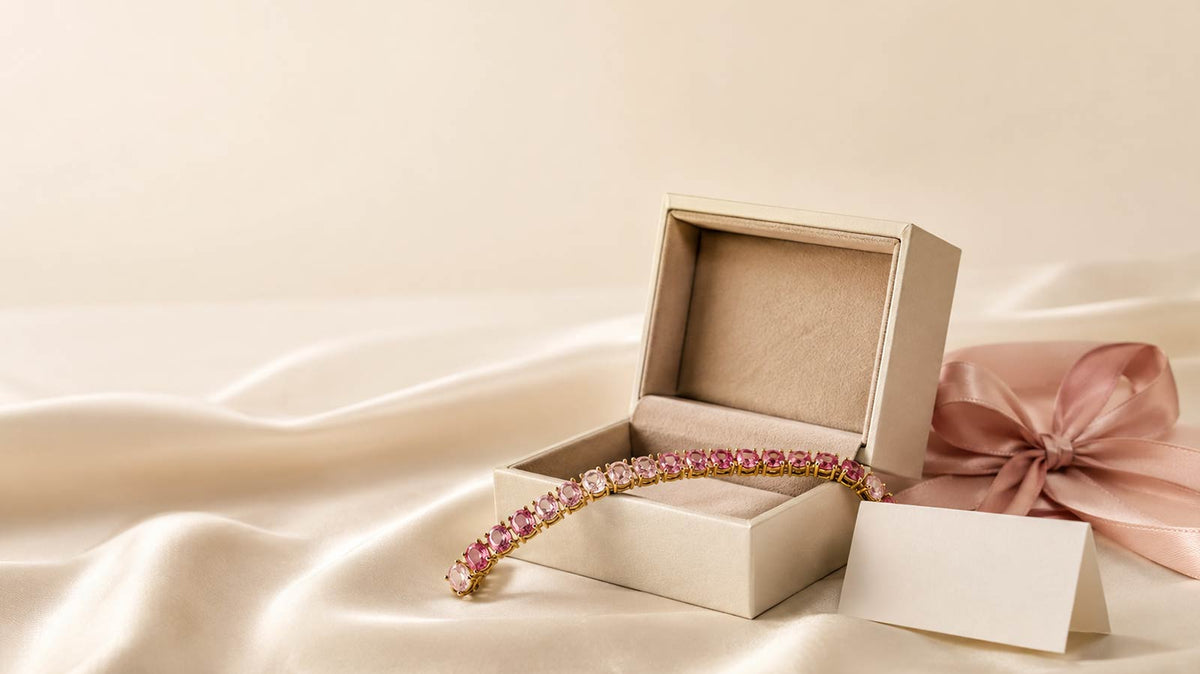
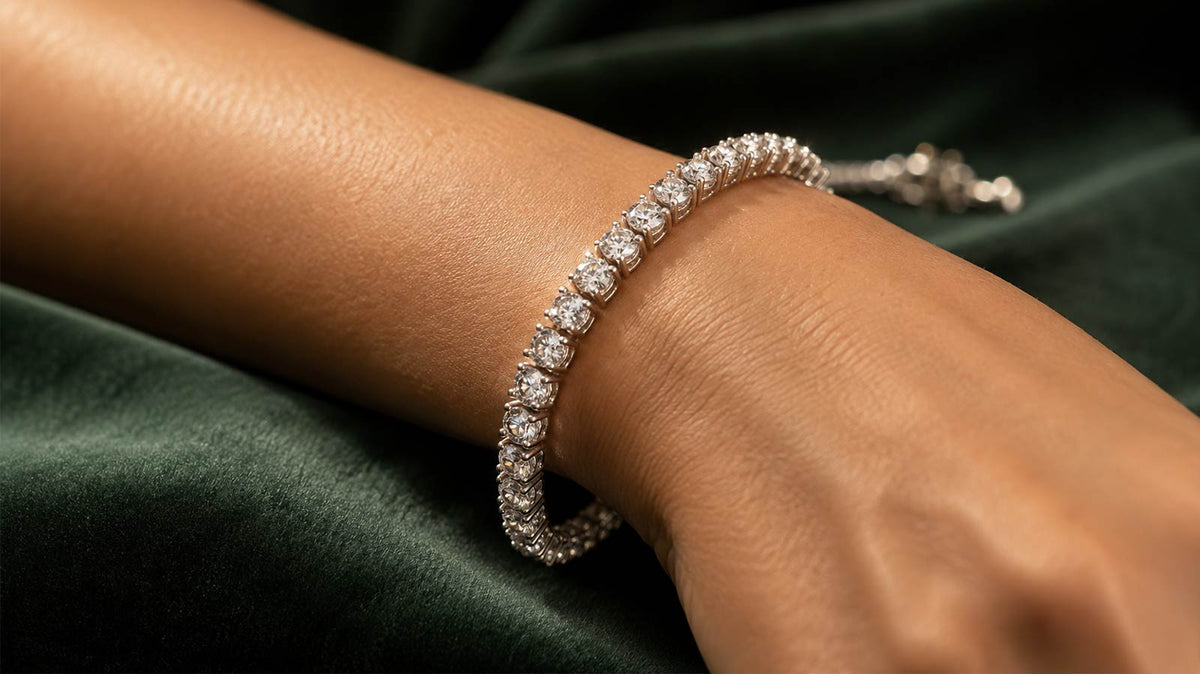
A tennis bracelet is a continuous line of stones set at even spacing around the wrist, flexible enough to move with you. That description covers a piece at £540 and a piece at £16,200, which is why the design itself tells you very little until you know what has been chosen inside it.
The choice that changes a tennis bracelet most is stone size. Everything else, the metal, the length, whether the stones are all diamond or alternating with colour, matters less than the step from 2.5mm to 5mm. Our bracelet collection carries the same design across both, and the difference is not subtle.
This guide covers what a tennis bracelet is, how stone size changes the carat weight and the price, how to pick a length, what each metal gives you, whether to go all diamond or alternate with a coloured stone, and what to ask about certification. Every figure comes from our own lab grown diamonds.
The short answer, before the detail
If you want the decision in five lines:
- Stone size is the main decision. At 7.5 inches, an all diamond bracelet runs from about 4.3 carats at 2.5mm to about 18.7 carats at 5mm.
- 2.5mm to 3.5mm reads as everyday. It sits flat, wears under a sleeve and does not ask for attention.
- 4mm to 5mm reads as an occasion piece. More weight, more presence, and a price that reflects both.
- Length is a fit decision, not a style one. Two standard lengths, plus custom if neither is right.
- At Juvetti these bracelets start at £780 all diamond, and £540 when a coloured stone alternates with the diamonds.
The rest of this guide is the reasoning behind those five lines, starting with the all diamond version in white gold.
What actually makes a bracelet a tennis bracelet
The design is simpler than the name makes it sound.
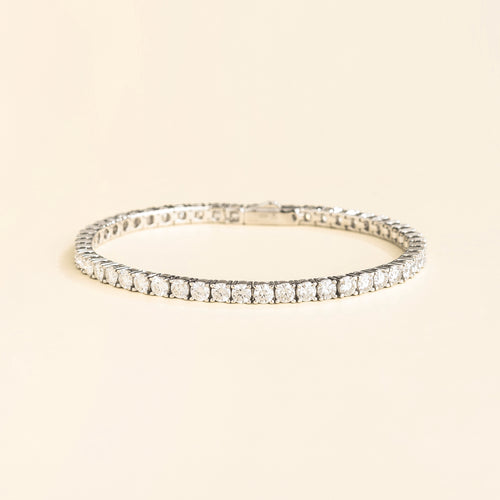
A tennis bracelet is a continuous line of stones, evenly matched and evenly spaced, set into a flexible chain of small links. Each stone sits in its own setting, and each setting hinges against its neighbours. That hinging is the whole trick: it lets a rigid line of hard stones follow the curve of a wrist and move as you move.
Two consequences follow, and both matter when you are choosing.
The stones must match each other closely. In a ring, one stone carries the piece. In a tennis bracelet, dozens of stones sit side by side in a line, and any that is noticeably different in size or colour shows immediately. That is a manufacturing demand rather than a marketing claim, and it is why the stones in this design are round cut and consistent rather than individually selected for character.
The piece is worn horizontally, at the edge of your field of view. A ring faces you. A bracelet mostly faces other people, and catches light from the side. That is worth remembering when you are weighing stone size, because presence at arm's length behaves differently from presence at reading distance.
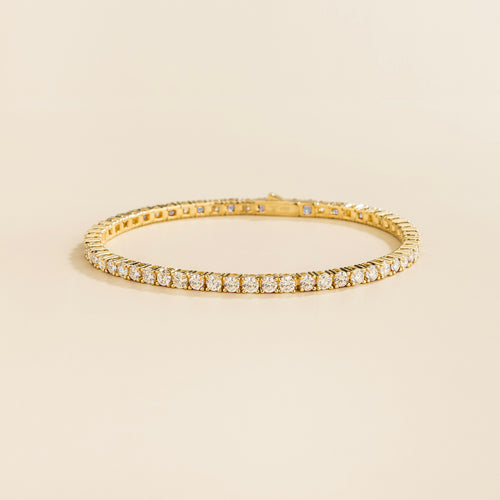
The same design in yellow gold makes the point about warmth and contrast that the next few sections turn on.
Stone size, and why it changes everything
This is the decision to make first, because every other choice sits inside it.
The stone sizes offered run 2.5mm, 3mm, 3.5mm, 4mm and 5mm. Those numbers sound close together. What they produce is not. On a 7.5 inch all diamond bracelet, the product page gives approximately 4.3 carats at 2.5mm and approximately 18.7 carats at 5mm, which is roughly four and a third times the weight across a range of a couple of millimetres per stone.
The reason is geometric rather than commercial, and it is worth following because it explains the shape of the price list too. A round stone's weight rises with the cube of its diameter, so a 5mm stone weighs roughly eight times a 2.5mm one. A wrist is a fixed length, though, so the larger stone means roughly half as many of them in the line. Eight times the weight each, about half the count, and the bracelet lands near four times the total. That is what the product page's figures show: about 4.3 carats at 2.5mm against about 18.7 carats at 5mm, a little over four times.
In practice the range divides into two pieces that behave quite differently:
A useful way to picture it: a 7.5 inch wrist is about 190mm of line to fill. At 2.5mm that is a great many small stones; at 5mm it is roughly half as many, each one four times the width of a grain of sand and carrying about eight times the weight of its smaller cousin.
Neither is the right answer. The useful question is whether you are buying something to wear on a Tuesday or something to wear twice a year, and the honest version of that question usually settles the size in a sentence.
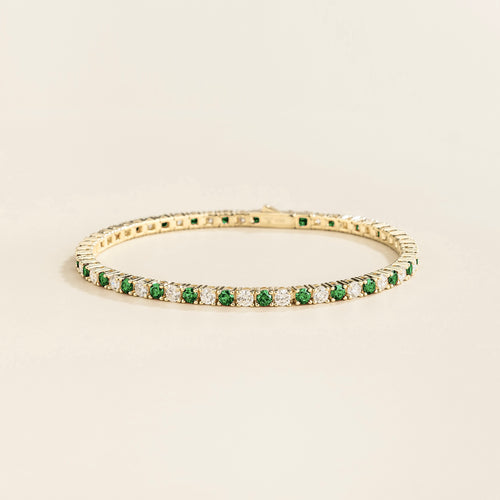
An alternating design shows the same size range with a second stone in the line, which is where the emerald version is worth a look.
Length, and getting the fit right
A tennis bracelet is one of the few pieces where fit is a real decision rather than a formality.
Two standard lengths are offered, 6.5 inches and 7.5 inches, with custom sizing where neither works. The difference is not only comfort. A bracelet that is slightly too long rotates on the wrist, so the clasp travels round to the top and the line of stones sits underneath. A bracelet that is slightly too short is uncomfortable in a way you notice all day.
The simple method: measure your wrist with a tape at the point where you would wear it, then add about half an inch to an inch. Less than that and the bracelet grips. More and it swings.
Two things worth knowing before you choose.
Length changes the carat weight and the price. A longer bracelet holds more stones of the same size, so the same design costs more at 7.5 inches than at 6.5. Every carat figure in this guide is for the 7.5 inch length, because that is what the product pages state. Ask us to confirm the carat weight at another length rather than scaling it yourself, since the stones come in whole numbers rather than fractions.
Custom sizing exists for a reason. Wrists are not standard, and a bracelet that fits properly is worn far more often than one that nearly fits. If you are between the two lengths, ask us rather than rounding.
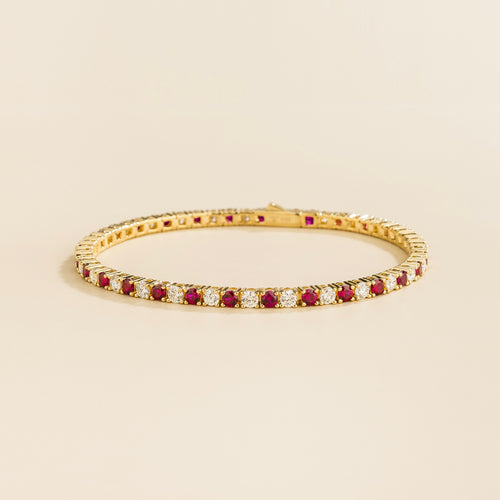
Colour changes how forgiving the line is about all of this, which the ruby version shows well.
Metal, from vermeil to 18K
Four options, and they differ in more than price.
The design is offered in gold vermeil, 9K, 14K and 18K gold, in both white gold and yellow gold. What separates them:
Gold vermeil is gold plated sterling silver, which is the description UK guidance requires, and vermeil is the trade word for it. It gives the look at the lowest point on the ladder and is a sensible way to try a design before committing. Because the gold is a layer, it wears the way plating wears rather than lasting like solid gold.
9K, 14K and 18K are solid gold alloys, and the number is the proportion of pure gold. Higher carat means a warmer colour in yellow gold and a softer metal. For a bracelet, which spends its life against desks, sleeves and door handles, that softness is worth thinking about. If you are unsure which suits regular wear, ask us to compare 9K, 14K and 18K for you against how you actually plan to wear it. Our 18K gold pieces sit at the richer end for anyone who prefers the colour.
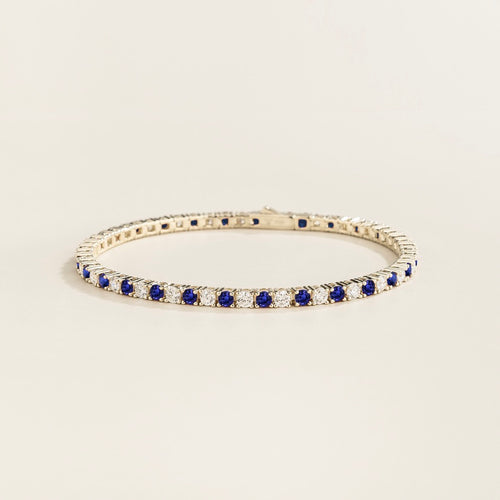
White gold and yellow gold do different jobs with the same stones. White gold keeps the whole piece in one register, so the line reads as continuous and nothing competes with the stones. Yellow gold sets a warm frame against them, which flatters warm coloured stones such as ruby and yellow sapphire, and creates more contrast against a colourless diamond.
A cool coloured stone against white gold is the other end of that idea, and the blue sapphire version is the clearest example.
All diamond, or alternating with colour
This is a taste decision with one practical consequence attached.
The all diamond version is a single continuous line of round lab grown diamonds. It is the classic, it goes with everything, and it is the version most people picture when they hear tennis bracelet.
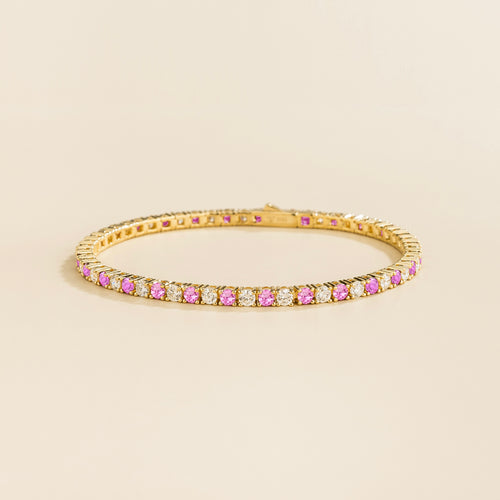
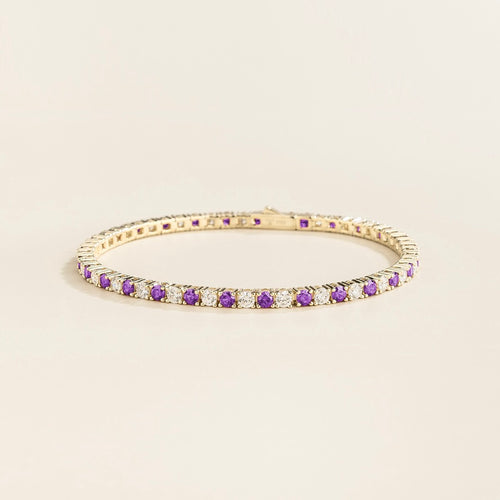
The coloured versions alternate a coloured stone with a diamond all the way round, so the line reads as a rhythm rather than a single texture. We offer that in emerald, ruby, blue sapphire, pink sapphire, purple sapphire, yellow sapphire and padparadscha sapphire.
The practical consequence is in the numbers, and it runs in both directions. The alternating versions start lower, at £540 against £780, and reach higher at the top, £16,200 against £15,700. Those ranges each span five stone sizes, four metals and three lengths, and the two lines hold different stones in different proportions, so no single factor explains the gap. It is worth knowing that the entry point is lower and the ceiling is higher, and worth resisting any tidy story about why.
One more thing that is easy to miss. In an alternating bracelet, roughly half the line is a coloured stone, so the piece carries less diamond than an all diamond bracelet of the same size. On the emerald version at 7.5 inches the product page gives about 1.7 carats of diamond alongside 2.4 carats of emerald at 2.5mm, rising to about 7.3 carats of diamond alongside 10.6 carats of emerald at 5mm. If total diamond weight is what you are buying, the all diamond version is the one to compare.
Certification, hallmarking and what to ask for
How lab grown diamond certificates work, and how IGI and GIA reports compare, is covered in full in our lab grown diamond certifications guide. What belongs here is the bracelet-specific part.
Two different documents, doing two different jobs, and it is worth knowing which is which.
The gemstone certificate describes the stones. Our product pages state that diamonds of 0.5 carats and above are accompanied by IGI or GIA certification. That threshold interacts with the size you choose. At the smaller end of this range each stone sits well under half a carat, so individual certificates are not the right question to ask. Towards 5mm, where the whole bracelet reaches roughly 18.7 carats across a line of stones, the individual stones come closer to that half carat mark. Either way the useful question is what the stones are specified at and what documentation comes with the finished piece. Ask us, and ask before you buy rather than after.
Grading itself is not a separate scale for laboratory grown stones. IGI grades them on the same colour and clarity ranges used for natural diamonds, and its reports state that a stone is laboratory grown rather than leaving it to be inferred. The clarity scale behind those grades is GIA's eleven grade system, judged under ten times magnification.
The hallmark describes the metal. A UK hallmark is, in the Assay Office's own words, a set of component marks that guarantees an article "conforms to all legal standards of purity (fineness)". Three marks are compulsory within it: the millesimal fineness mark, the Assay Office mark and the sponsor's mark. We would rather not set out the rules on when hallmarking is compulsory without a source we can stand behind, so the best route is simply to ask us to confirm the hallmarking status of the piece you are considering, and we will tell you plainly.
The purple sapphire version below is a good example of a piece worth asking both questions about, since the stone and the metal are each doing visible work.
Before you choose
Two practical points to settle before you order, and one hand-off.
Decide the length with a tape measure rather than a guess. It is the one decision on this list that cannot be adjusted later without work, and a bracelet that fits properly is worn far more often than one that nearly fits.
Decide the stone size against how often the piece will be worn, not against how it photographs. The everyday end and the occasion end of this range are genuinely different objects.
For cleaning and ongoing care, and for how the karat options compare in wear, see our 9K vs 14K gold guide.
If the bracelet is a gift rather than a purchase for yourself, our guide to why a lab grown diamond bracelet makes a modern gift makes that case on its own.
Frequently Asked Questions
What size stones should I choose for a tennis bracelet?
It depends on how often you will wear it. Between 2.5mm and 3.5mm the bracelet sits close to the wrist, slides under a sleeve and suits everyday wear. At 4mm to 5mm it becomes noticeably wider and heavier, and reads as an occasion piece. The gap is larger than the millimetres suggest: on a 7.5 inch all diamond bracelet the product page gives about 4.3 carats at 2.5mm and about 18.7 carats at 5mm, because a round stone's weight rises with the cube of its diameter.
How much does a lab grown diamond tennis bracelet cost?
At Juvetti the all diamond version runs from £780 to £15,700, and the versions that alternate a coloured stone with diamond run from £540 to £16,200. Each range spans five stone sizes, four metals from gold vermeil to 18K, and two standard lengths plus custom, so the figure that matters is the combination you actually choose rather than the starting price. Tell us the size and metal you have in mind and we will give you the exact figure.
How should a tennis bracelet fit?
Measure your wrist where you would wear it and add about half an inch to an inch. Too loose and the bracelet rotates, so the clasp travels to the top and the stones sit underneath. Too tight and you will notice it all day. Two standard lengths are offered, 6.5 and 7.5 inches, and custom sizing exists precisely because wrists are not standard. If you fall between the two, ask rather than rounding.
A tennis bracelet is one design holding a very wide range, and almost all of that range comes from a decision most people make last: how big the stones are.
Settle that first, in honest terms about how often the piece will actually be worn. Length is a fit question with a tape measure behind it. Metal is a question of colour and of how hard the piece will live. Whether the line is all diamond or alternates with colour is taste, with one number attached, which is how much diamond you end up owning.
You can see the full bracelet collection with current prices for every size and metal, and our team will be glad to work out the exact figure for the combination you have in mind.

Prepared by the Juvetti editorial team and reviewed by Nanon of Juvetti. Product details, prices and availability were checked against the current Juvetti product pages, and grading and hallmarking information was checked against GIA, IGI and Assay Office sources. Prices change, so please check the current product page before deciding.