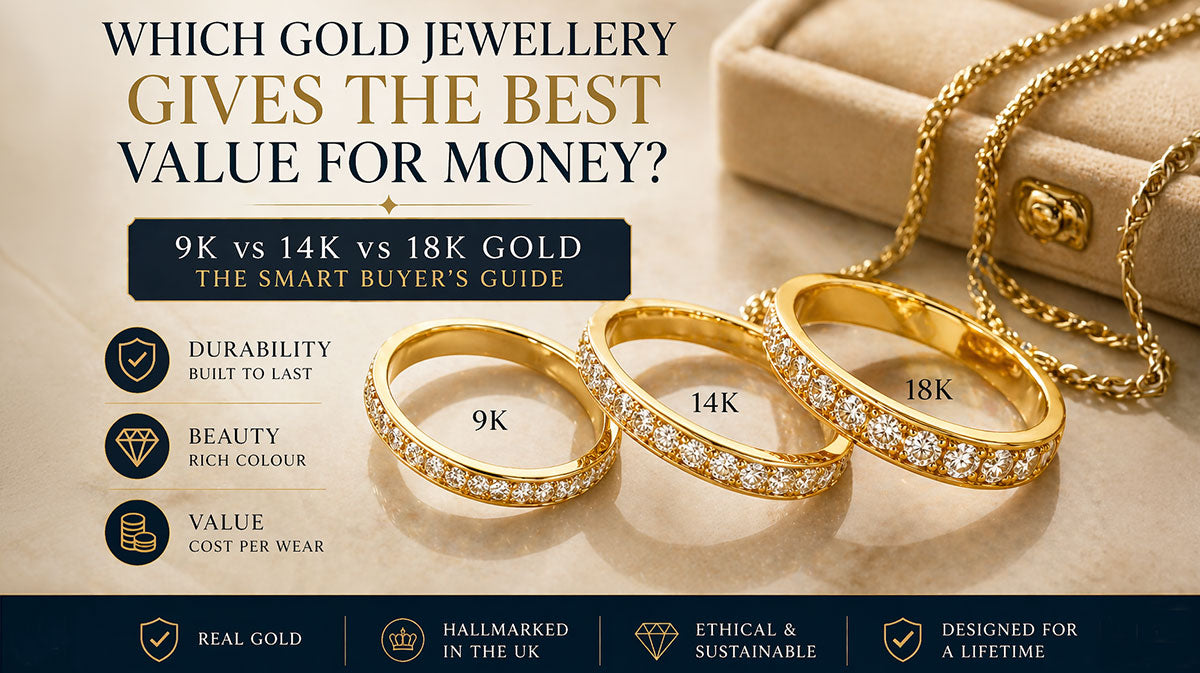
Which Gold Jewellery Gives the Best Value for Money? 9K, 14K or 18K
Most buyers approach gold jewellery with one question in mind: what is the best I can afford? That is the wrong question. The right question is: which gold gives me the most value for the way I actually wear jewellery? Value and price are not the same thing. The most expensive piece is not always the smartest buy, and the most affordable option is not always the wisest choice either.
This guide cuts through the karat confusion and delivers the verdicts that experienced buyers already know: not which gold is cheapest, but which gold karat gives the most for your money across durability, appearance, longevity, and the cost per wear that makes a piece genuinely worth owning.
Quick Answer: Which Gold Karat Is Best Value?
If you are short on time, here is the honest verdict before the detail:
- Best overall value for money: 14K gold. The smartest buy for most UK buyers. Richer colour than 9K, strong durability, meaningful gold content, and a price that does not require you to compromise elsewhere in your collection.
- Best practical value for everyday wear: 9K gold. The most cost-effective real gold available. Hardest, most scratch-resistant, and lowest cost per wear of any standard. The right call for rings and bracelets worn through everything.
- Best luxury value for specific situations: 18K gold. Worth the premium for special occasion pieces, milestone gifts, and heirlooms where visual richness matters more than mechanical performance.
Everything below explains the reasoning behind those verdicts and helps you apply them to your specific situation.
What "Value for Money" Actually Means in Gold Jewellery
Value in jewellery is not a fixed number on a price tag. It is the relationship between what you pay and what you receive across the entire life of the piece. A ring that costs £300 and looks stunning for five years before showing significant wear has delivered less value than a £500 ring that remains beautiful for twenty.
True value in gold jewellery comes from four things:
- Metal content relative to price - how much actual gold you are paying for, not alloy filler
- Durability relative to cost - how well the piece holds up under real wearing conditions over the long term
- Cost per wear - the total price divided by how often and how long the piece is worn
- Resale and intrinsic value - what the metal itself retains across years and decades
When you apply these four measures rather than simply comparing ticket prices, the answer shifts considerably. And for most buyers in the UK market, the conclusions are perhaps more decisive than expected.
Best Gold Karat for Value: The Short Verdict
Here is the fast-reference table experienced buyers wish they had found earlier.
Best Value by Buyer Scenario
The question "which gold gives the best value for money?" has a different answer depending on who is asking. Here is a scenario-by-scenario verdict.
Best Value for Everyday Wear: 9K Gold
If you never take it off, 9K gold is almost always the smartest buy. It is the hardest of all standard gold alloys, the most scratch-resistant, and the most cost-effective real gold available in the UK market. The value case is not about compromise. It is about matching the metal to the mission. A ring worn daily through cooking, manual work, sport, and everything in between belongs in a hard-wearing alloy, not a softer, more expensive one that will show every knock.
Browse 9K gold pieces designed for everyday wear at Juvetti
Best Overall Value: 14K Gold
For most buyers comparing gold karat value, 14K gold is the most considered choice. It delivers a noticeably richer colour than 9K, holds up excellently under most everyday conditions, and carries a meaningful gold content that gives it genuine long-term worth. The price premium over 9K is real but not dramatic. What you receive in return is a piece that reads unmistakably as fine gold and performs well across the vast majority of wearing situations. This is why 14K dominates global fine jewellery markets.
Explore 14K gold jewellery for the best balance of richness and value at Juvetti

Best Value for First-Time Buyers
If this is your first real gold purchase and you want to know you are not overpaying, 9K or 14K gold are the two strongest choices in the UK market. Both are fully hallmarked and regulated. Both are solid gold throughout. Neither is plated, filled, or simulant. For a first piece that will be worn regularly and stand the test of daily life, these two karats represent the most intelligent entry point into best value real gold jewellery.
Best Value for Gifting
The right choice for a gift depends on how it will be worn. For a gift worn daily, 9K or 14K delivers the best value gold for daily wear. For a milestone gift, an anniversary present, or something intended to feel genuinely significant and luxurious in the hand, 18K gold earns its premium. The richer colour and the weight of the metal content communicate value in a way that matters when a piece carries emotional meaning.
Best Value for Budget-Conscious Buyers Who Want Real Gold
9K gold is the most cost-effective real gold available in the UK, full stop. It is not a budget compromise. It is a rational choice. The gold is genuine, the hallmark is real, and the durability is outstanding. For buyers who want the most for their money without any sacrifice on quality, 9K is the answer.

Best Value by Jewellery Type
The best gold karat for value changes depending on what you are actually buying. Here is the verdict by piece type, without the hedging.
Rings
Best value: 9K for daily wear rings; 14K for occasion rings. Rings on the dominant hand face more mechanical stress than any other jewellery type. The hardness advantage of 9K gold is most meaningful precisely here. A 9K ring worn every day for twenty years will hold its surface, maintain its setting, and stay beautiful with normal care. That is the definition of best value gold for daily wear. For rings worn less often or where colour richness is central to the design, 14K is the stronger choice. For a full comparison of how these two standards perform in rings, read our 9K vs 14K gold guide.
Necklaces and Pendants
Best value: 14K. Necklaces and pendants face considerably less surface friction than rings and bracelets. The durability gap between 9K and 14K matters far less here, which means the richer colour of 14K is worth the modest premium. A 14K pendant worn close to the face reads as unambiguously fine gold, and it will perform beautifully for decades without the same maintenance demands as softer 18K alternatives.
Bracelets
Best value: 9K for active wear; 14K for occasional pieces. Bracelets occupy a middle ground, facing more daily contact than necklaces but generally less than rings. For those worn without removal through physical activity, 9K gold's practical hardness advantage delivers meaningfully better longevity per pound spent.
Earrings
Best value: 14K, particularly for sensitive wearers. Earrings experience less surface friction than other jewellery types, reducing the significance of 9K's hardness advantage. For earrings worn in prolonged skin contact, 14K gold's higher gold content and proportionally lower allergen exposure make it the more considered choice for most buyers. For more detail on how each karat performs across different piece types, read our 14K vs 18K gold comparison.
Cost Per Wear: Why 9K and 14K Often Win
The buyers who build the most satisfying jewellery collections rarely think about price in isolation. They think about cost per wear: the total price divided by the number of times a piece is worn across its lifetime. Apply this thinking directly, and the value calculation becomes clear.
A 9K gold ring purchased for £350 and worn every single day for fifteen years has a cost per wear of less than seven pence. A more expensive piece at £900, worn occasionally over the same period, delivers far less value per outing. The daily wear ring, chosen for its hardness and its price efficiency, earns its cost many times over.
This is the principle that experienced buyers apply consistently: for pieces worn frequently, prioritise durability and price efficiency. For pieces worn rarely but meaningfully, invest in richness of metal and colour. These are not contradictory positions. They are the natural logic of a well-constructed collection.
9K and 14K gold both win convincingly on cost per wear for the pieces that live on the body every day. Their greater hardness means they maintain surface quality longer without professional intervention. Their lower price means the same budget stretches further, whether into a larger design, a finer gemstone, or a second piece entirely.
When 18K Gold Is Worth Paying For
This article is a value-for-money guide, and the honest position is that 18K gold earns its premium in specific situations only. Those situations are real and worth acknowledging clearly.
18K gold is the right choice when the piece is worn infrequently enough that softness is not a concern, when visual richness and a deeper golden colour are the primary requirements, and when the emotional or investment weight of the purchase justifies the higher spend. Milestone anniversary jewellery, a gift of genuine significance, a pendant reserved for important occasions, or a piece intended as a family heirloom: these are where 18K gold's colour, prestige, and higher intrinsic gold content deliver returns that match the price.
For active daily wear, for rings on working hands, for bracelets worn through sport and physical activity, 18K gold is not the best value choice. Its softness means it shows wear sooner and may require more frequent professional maintenance. The premium is real and so is the trade-off.
Discover 18K gold pieces for milestone gifts and heirloom-worthy occasions at Juvetti

Best Gold Colour for Long-Term Value
Gold colour affects the total cost of ownership more than most buyers realise. The smartest value choice is not just about karat. It is also about maintenance. For the full breakdown of how yellow, white, and rose gold compare, read our complete white gold vs yellow gold vs rose gold guide.
Yellow Gold: Lowest Total Cost of Ownership
Yellow gold requires no ongoing maintenance beyond regular cleaning. It does not need rhodium re-plating. It does not develop a cream undertone as the years pass. It ages naturally and gracefully. For buyers who want the most honest long-term value with no hidden maintenance cost, yellow gold in 9K or 14K is the most cost-efficient choice available.
White Gold: A Small Ongoing Cost to Factor In
White gold requires periodic rhodium re-plating to maintain its bright, platinum-like finish, typically every twelve to twenty-four months depending on wear. That is not a reason to avoid it, but it is a real ownership cost that yellow and rose gold do not carry. When comparing value between white gold and other colours, factor in the plating cost across the piece's lifetime.
Rose Gold: Strong Durability, No Plating Required
The copper content that gives rose gold its distinctive blush also contributes meaningfully to the alloy's hardness. Rose gold in 9K and 14K is among the most durable colour options available, requires no rhodium plating, and ages warmly without visible deterioration. For buyers who want low-maintenance value with a distinctive aesthetic, rose gold is an exceptionally strong choice.
How to Build a High-Value Gold Jewellery Collection
The most satisfying collections are not built by choosing one karat for everything. They are built by matching the right karat to the right piece and the right purpose. Spending strategically across a collection means every pound works precisely as hard as it should.
- Daily wear rings on the dominant hand - 9K gold. Hardest, most resilient, best cost per wear of any standard.
- Stacking rings and bands worn less intensively - 14K gold. Richer colour, still highly durable, worth the modest premium.
- Chain necklaces worn every day - 9K or 14K, depending on whether price or colour richness takes priority.
- Pendants and statement necklaces - 14K. Less daily contact means the colour premium is money well spent.
- Actively worn bracelets - 9K or 14K. Constant surface contact rewards hardness.
- Earrings for sensitive skin - 14K. Higher gold content, lower allergen exposure, strong durability for pieces worn close to the body.
- Milestone gifts and heirloom pieces - 18K. The richness of colour and the intrinsic gold content justify the investment when emotional and visual impact matter most.
This is not about spending less. It is about spending with intention. Every karat has a place in a considered collection. The mistake is paying 18K prices for pieces that live through 9K conditions.
Why Juvetti Gold Holds Its Value
At Juvetti, value is built into the process before the piece ever reaches the wearer. Every piece uses recycled gold and lab-cultivated gemstones that share the same chemical structure, optical properties, and physical characteristics as mined stones, without the environmental and ethical cost that mining carries. Our workshops are Responsible Jewellery Council certified, and every piece is individually handcrafted to the highest standard.
When you invest in Juvetti gold, you are investing in a piece designed to perform and remain beautiful for decades. That is the only definition of value that endures.
Frequently Asked Questions
Which gold karat gives the best value for money in the UK?
For most buyers, 14K gold offers the best overall value for money, delivering a balance of richer colour, strong durability, and meaningful gold content at a price that does not require compromise. For heavily worn everyday pieces, 9K gold is the best practical value. For heirlooms and special occasions, 18K earns its premium.
Is 9K gold good value for money?
Yes, and for active daily wear it is often the smartest buy available. 9K is the hardest standard gold alloy, the most scratch-resistant, and the most cost-effective real gold in the UK market. Its cost per wear for daily pieces is outstanding, and it is the most widely purchased gold standard in Britain for exactly this reason.
Am I overpaying if I buy 18K gold for everyday wear?
For pieces worn actively every day, yes, 18K gold represents a less efficient use of budget than 9K or 14K. Its higher gold content makes it softer, meaning it shows surface wear sooner under demanding daily conditions. The premium is real and so is the trade-off. For active daily wear, 9K or 14K is the better value choice. For more detail, read our 14K vs 18K gold comparison.
What is the best gold karat for everyday rings?
9K gold is the best value gold for daily wear rings. Its superior hardness resists surface scratching, maintains prong integrity, and delivers a low cost per wear across years of continuous use. 14K is the right choice when a richer colour is the priority and the ring is not subjected to the most demanding conditions. For full detail, see our 9K vs 14K gold guide.
Does gold colour affect the overall value for money?
Gold colour does not affect the metal value itself, but it does affect maintenance costs and therefore the total cost of ownership. Yellow gold and rose gold require no plating and no ongoing maintenance beyond cleaning, making them more cost-efficient over a long wearing life. White gold requires periodic rhodium re-plating to maintain its bright finish. For the full comparison, see our white gold vs yellow gold vs rose gold guide.
What gold gives the most for your money as a first purchase?
For a first gold purchase, 9K or 14K gold offer the best value real gold jewellery in the UK. Both are fully hallmarked, genuinely solid gold throughout, and built to last. Neither is plated, filled, or a simulant. For a first piece worn regularly, these two karats are the most intelligent entry point.
Which gold holds its value best over time?
Higher karat gold contains more pure gold by weight, so the intrinsic metal value in each 18K piece is proportionally greater than in a 9K equivalent. For buyers with a strong investment consideration, 18K retains more value in the metal itself. To understand whether gold jewellery works as a financial investment, read our guide on whether gold jewellery is a good investment. For pieces where wearing performance matters more than metal weight, 9K and 14K offer superior durability-to-cost returns across the piece's lifetime.