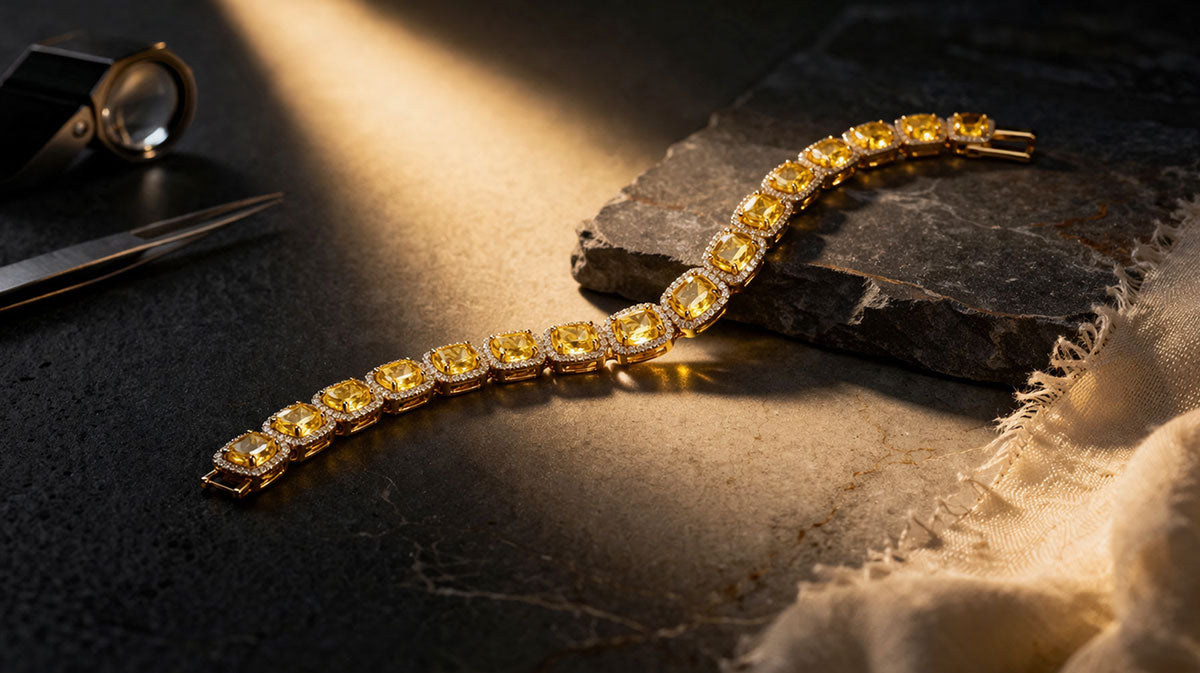
Yellow Sapphire Bracelet Buying Guide: How to Choose the Perfect One
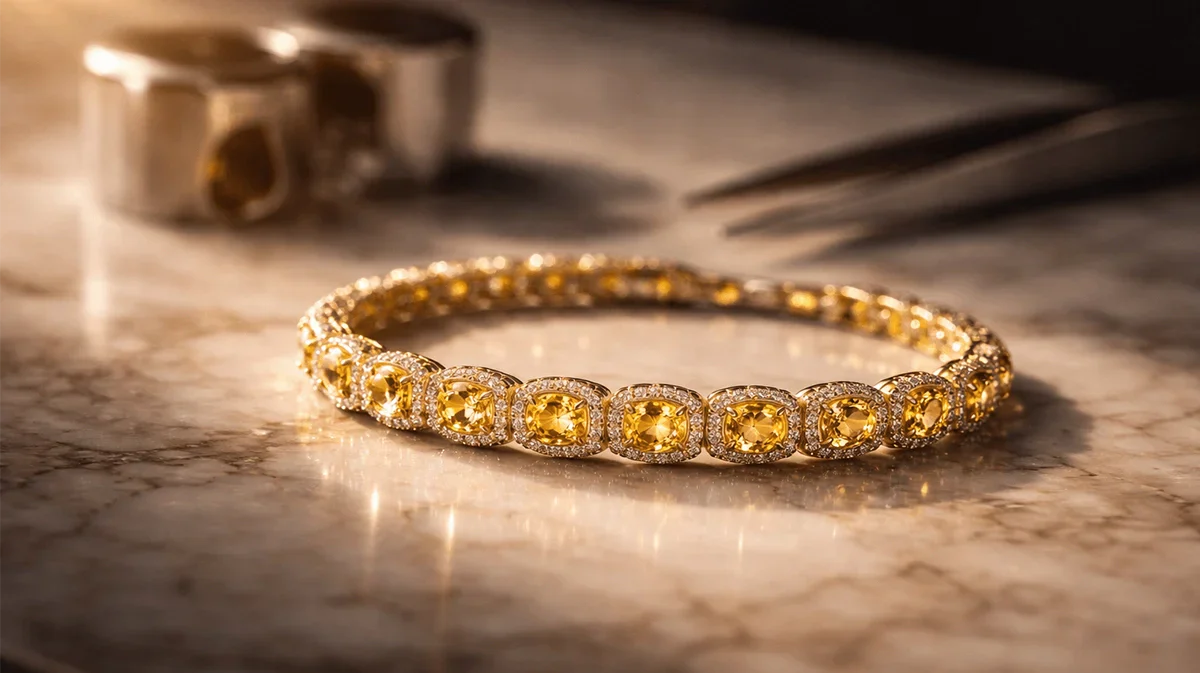
There is something singular about the way yellow sapphire looks on the wrist. As the light shifts with every movement, the stone responds, catching warmth, throwing gold, turning an ordinary gesture into something quietly luminous.
No other piece of jewellery moves quite the way a bracelet does, and few gemstones reward that movement as generously as yellow sapphire. Yet choosing a yellow sapphire bracelet is more nuanced than most buyers anticipate.
Budget matters, of course, but it is only one variable among many. Lifestyle, wrist proportion, gemstone quality, and setting integrity all shape whether a bracelet will feel right for years to come.
Yellow sapphire is having a sustained moment in fine bracelet jewellery, and for good reason. Its versatility across metals and occasions, its exceptional hardness, and its colour range make it one of the most rewarding gemstones to wear at the wrist.
But there is one quality factor that matters more in a bracelet than in any other jewellery type: colour consistency across every stone in the piece. By the end of this guide, you will know exactly which yellow sapphire bracelet suits your wrist, your wardrobe, and your values.
Why Yellow Sapphire Works So Well as a Bracelet Gemstone
The Visual Power of Yellow Sapphire in Motion
Bracelets move differently from all other jewellery. A ring sits largely still, a necklace sways in a single plane. A bracelet rotates, lifts, and catches light from every direction with every turn of the wrist.
Yellow sapphire's high refractive index, 1.76 to 1.78, means it refracts light with exceptional intensity. Combine that with colour saturation ranging from pale lemon through golden yellow to vivid canary, and you have a stone that performs beautifully in motion.
The colour range is worth dwelling on. Paler lemon stones have a cool, contemporary quality. They read as sophisticated and modern. Deeper canary yellows are warmer, more opulent, more immediately eye-catching. Both have their place. The question is: which serves your aesthetic and metal choice best?
Yellow Sapphire Against Other Coloured Gemstone Bracelets
Why choose yellow sapphire over emerald, ruby, or blue sapphire for the wrist? The honest answer is versatility. Emerald is beautiful, but it ranks 7.5 to 8 on the Mohs hardness scale and is often more prone to fracturing due to natural inclusions. Yellow sapphire ranks 9 and is generally more durable for daily wear.
Ruby reads as more formal, more occasion-specific. Blue sapphire is classic and enduring, but it lacks the warmth that makes yellow sapphire especially wearable across both casual and formal settings.
Yellow sapphire's greatest advantage is its natural harmony with gold metals, both yellow and rose, combined with a striking contrast effect on white gold and platinum. It is a stone that adapts well, durable enough for daily wear without the anxiety that accompanies more fragile coloured gems.
The Symbolism Worth Wearing Every Day
Yellow sapphire has long been associated with prosperity, wisdom, and joy across Vedic tradition, Western gemology, and contemporary fine jewellery. These are not abstract ideas when you are choosing something to wear every day.
What does the jewellery you choose to wear daily say about who you are? For many buyers, the answer lies precisely in that combination: something beautiful, durable, and intentional. Yellow sapphire delivers all three. You can explore the full breadth of what this gemstone offers across our yellow sapphire jewellery collection.
Understanding Yellow Sapphire Quality in a Bracelet Context
Colour Consistency Across Every Stone
In a solitaire ring, colour is assessed once. In a bracelet, it must be assessed across every stone in the line. Colour consistency is the single most critical quality factor in a yellow sapphire bracelet, and it is where many buyers and many jewellers fall short.
At wrist distance, the eye reads the bracelet as a whole. One stone that drifts towards greenish yellow, or one that sits visibly paler than its neighbours, immediately disrupts the visual harmony of the entire piece. This is a flaw that cannot be corrected after purchase.
When assessing colour, consider three things:
- Hue: is it a true yellow, or does it drift towards orange or green?
- Saturation: vivid canary vs soft lemon, both have merit, but be clear which you are buying
- Tone consistency across the full bracelet line
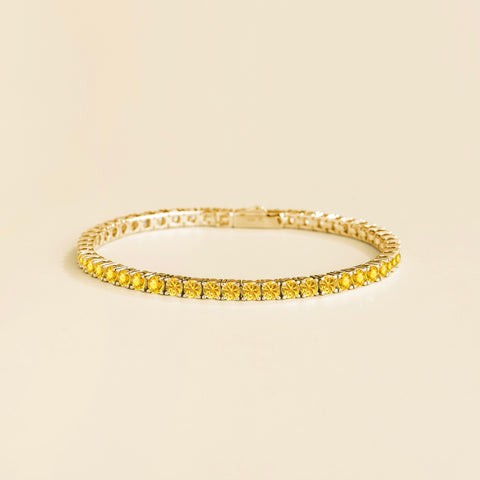
Warm undertones harmonise naturally with yellow gold. Cooler or purer yellows look striking against white gold or platinum.
Clarity: The Practical Standard for Bracelets
In a bracelet worn in motion, inclusions behave differently than in a ring held up to direct light. The practical standard for yellow sapphire bracelets is eye-clean: free from visible inclusions when viewed at normal wrist distance.
Fine needle-like inclusions, or slight cloudiness that does not disrupt the stone's face-up colour, are broadly acceptable. Included stones that fracture light unpredictably or appear milky will diminish the bracelet's overall luminosity, and because bracelets are multi-stone pieces, that effect is compounded across the line.
One practical note: lab-grown yellow sapphires often achieve higher clarity consistency across multi-stone pieces than their natural counterparts, a meaningful advantage in bracelet design.
Cut Precision Across a Bracelet Line
A bracelet demands uniformity of cut as much as individual brilliance. A single poorly proportioned stone in a bracelet line immediately draws the eye, and not in a good way.
For tennis and channel-set bracelets, calibrated cuts, stones cut to precise uniform dimensions, are not optional. They are what allow the bracelet to sit flat, flow elegantly, and catch light evenly across its full length. A well-cut yellow sapphire glows. An over-deep or flat-cut stone looks dull regardless of its natural colour.
Natural vs Lab-Grown Yellow Sapphire Bracelets
What Lab-Grown Actually Means
Lab-grown sapphires are chemically, physically, and optically identical to natural sapphires. They share the same corundum composition, the same Mohs 9 hardness, and the same refractive properties. They are not simulants, and this is a crucial distinction. Cubic zirconia and nano crystals do not share these physical properties, and they show it over time.
Juvetti's lab-grown yellow sapphires are produced through sustainable, energy-powered growth processes, and each piece is crafted from recycled metals, making them the considered choice for buyers who care about what their jewellery represents, not just how it looks.
Where Natural and Lab-Grown Differ
Four practical differences matter to a bracelet buyer:
Clarity and colour consistency: Lab-grown allows for more uniform multi-stone sets, a meaningful advantage in a bracelet where every stone is visible and compared against its neighbours.
Traceability and ethical provenance: Lab-grown stones have a fully transparent supply chain. Natural sapphire sourcing, particularly from certain regions, remains difficult to verify.
Value: Lab-grown enables larger carat weights or more stones within the same investment. A lab-grown yellow sapphire bracelet can deliver superior colour and clarity at a significantly lower price point than its natural equivalent.
Treatment transparency: The vast majority of natural yellow sapphires are heat-treated to enhance their colour. This is standard industry practice, but it should be disclosed clearly by any reputable seller.
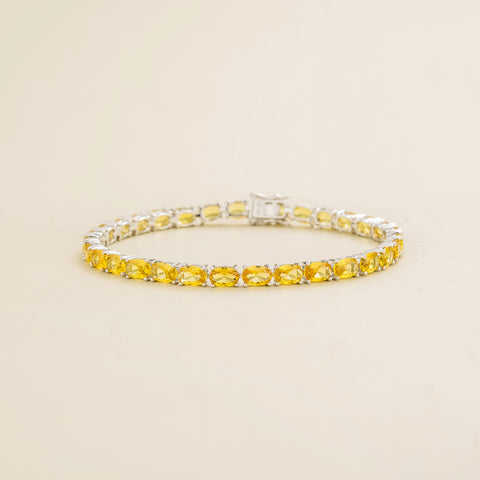
Which Is Right for You?
This is a values and priorities question, not a quality hierarchy. Is the geological story behind your stone important to you, the millions of years of heat and pressure that created something unique? Or is it the integrity of the stone itself, its beauty, its consistency, and the transparency of where it came from that matters most?
Both are valid answers. Juvetti's yellow sapphire bracelet collection is designed around the latter conviction: that the finest jewellery should be as beautiful in its ethics as it is on the wrist.
Bracelet Styles: Choosing the Right Design for Your Wrist
The bracelet style you choose depends on three things: how you live, what you like to wear, and how your wrist is proportioned. Each style carries a different visual weight, a different occasion logic, and a different relationship with the yellow sapphire as a gemstone.
Yellow Sapphire Tennis Bracelets
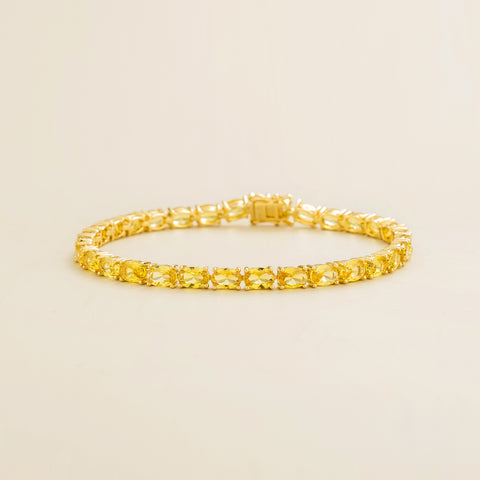
The tennis bracelet is the most iconic and enduring format for yellow sapphire. Defined by a continuous line of uniformly set stones on flexible links, it creates an unbroken band of colour and light around the wrist that moves with extraordinary elegance.
Setting options include four-claw for maximum light exposure, bezel for a sleek modern look and greater security for active wearers, and channel for seamless stone-to-stone continuity.
Wrist sizing is a critical consideration that many buyers overlook. A tennis bracelet should lie flat and move gently, not rotate constantly, not dig in. As a guideline, add approximately 1 to 1.5cm to your wrist circumference for the ideal fit.
Yellow Sapphire Bangles
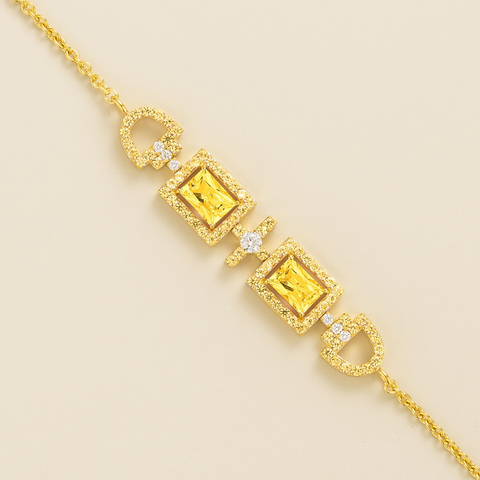
Where a tennis bracelet moves with the wrist, a bangle commands attention in stillness. It has an architectural quality: rigid, sculptural, and immediate. Yellow sapphire bangles work exceptionally well alongside plain yellow gold or diamond styles, and a single sapphire bangle worn alone is a statement in itself.
The practical distinction between slip-on and hinged bangles matters for daily wear. Hinged styles are more universally wearable and easier to put on and take off without assistance.
Yellow Sapphire Chain Bracelets
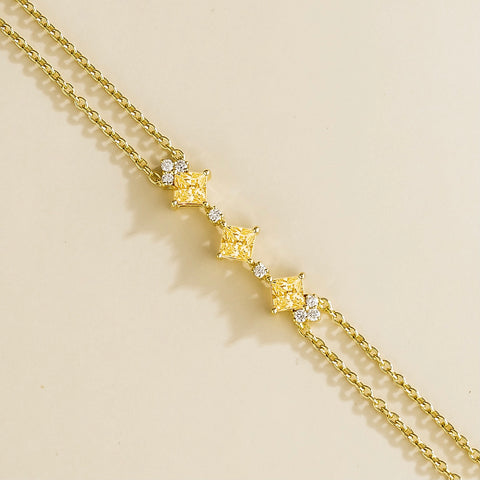
For buyers who prefer minimalist luxury, a chain bracelet set with yellow sapphire drops or accent stones is the answer. Maximum elegance with minimum weight, sitting on the wrist with a lightness that more structured styles do not share.
Adjustable chain lengths are a practical advantage, giving flexibility across seasons, layering styles, and wrist sizes. Chain bracelets pair naturally with pieces from our yellow sapphire jewellery collection for those building a considered jewellery wardrobe.
Yellow Sapphire Cuff Bracelets
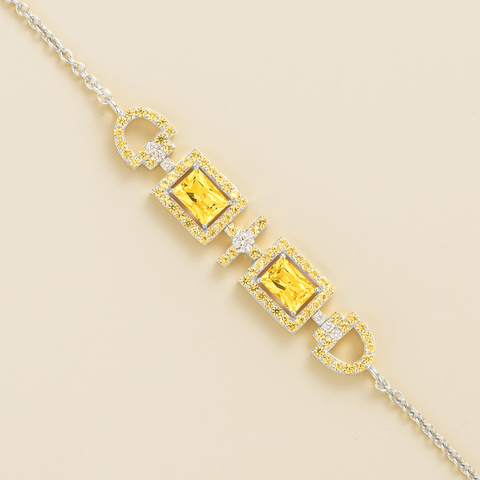
A cuff is designed to be seen. Bold, editorial, and architectural, it commands attention in a way that other bracelet styles do not. Yellow sapphires function beautifully as focal points within cuff structures, either as a centrepiece stone surrounded by pavé diamonds, or as a series of accent stones following the cuff's contour. Best understood as occasion-led rather than daily-wear pieces.
Carat Size: How Much Yellow Sapphire Do You Actually Need?
Why Carat Thinking Differs in Bracelets
A bracelet distributes stones across the wrist rather than concentrating them in a single focal point. This changes everything. Total carat weight across the bracelet line is more meaningful than individual stone size. A 5ct yellow sapphire tennis bracelet composed of well-matched 0.20ct stones will almost always outperform a piece with fewer, larger stones of variable colour.
While yellow sapphire is denser than diamond, meaning a 1ct sapphire is physically smaller than a 1ct diamond, the significant price advantage of sapphire means you can select a larger stone that offers a far more substantial face-up appearance than a diamond at the same price point.
Have you ever tried on a bracelet that felt immediately right without knowing exactly why? Proportion is nearly always the answer.
Recommended Carat Ranges by Style
- Tennis bracelet: total carat weight 3 to 8ct across the full line; individual stones typically 0.10 to 0.50ct each
- Bangle with sapphire accents: feature stones 0.50 to 1.50ct; accent pavé 0.05 to 0.15ct each
- Chain bracelet: 0.25 to 1.00ct per drop or feature stone
- Cuff: 1.00 to 3.00ct for a centrepiece stone; pavé adds total weight depending on coverage
Wrist Size and Proportion: The Factor Most Buyers Overlook
Wrist circumference shapes how carat weight and bracelet width read visually. Delicate wrists suit finer settings, lower carat totals, and elongated designs. Broader wrists carry wider bangles, fuller tennis lines, and statement cuffs with natural ease.
If you are purchasing without trying on, measure your wrist circumference carefully and ask for guidance on bracelet width relative to that measurement. It is a conversation worth having before you commit.
Setting Styles: How Yellow Sapphire Is Held Changes Everything
The setting is not merely an aesthetic choice. It determines how secure the stones are, how much light they receive, and how the bracelet wears over time.
Prong Settings: Maximum Light, Maximum Colour
Prong settings expose the maximum surface area of each stone to light, allowing the yellow sapphire's colour to read at its most vivid. Four-claw settings are common in tennis bracelets; six-claw settings offer marginally more security. In a quality piece, prong tips are rounded and polished to eliminate any snagging risk.
Bezel Settings: Security Meets Modernity
In a bezel setting, each stone is encircled by a thin metal collar offering superior protection against impact and no snagging risk. The aesthetic is sleek and contemporary. Bezel-set yellow sapphire tennis bracelets are the preferred choice for active wearers, or anyone who wants the security of knowing their stones are safely enclosed without compromising on elegance.
Channel Settings: Seamless Elegance
In a channel setting, stones sit between two parallel rails of metal with no individual prongs between them. The effect is stone-to-stone continuity: the entire bracelet reads as a single luminous line. Channel settings also protect the girdle of each stone from chipping, but they demand precise cutting to sit flush and flow correctly.
Pavé and Micro-Pavé
Yellow sapphire as pavé, either as the primary stone or as an accent alongside diamonds, creates exceptional density of colour and light. Micro-pavé accents around a central stone bring warmth and richness to more understated designs. Pavé settings do require more careful handling over time, as the small beads of metal holding each stone can wear down with heavy use.
Metal Choice: What Frames Your Yellow Sapphire
Yellow Gold: The Natural Partner
Yellow gold is the most complementary metal for yellow sapphire, warmth meeting warmth in a pairing that has defined fine jewellery for centuries. For a fine bracelet intended for regular use, 18ct yellow gold is the standard to aim for: richer colour, more luxurious feel, and a quality that rewards daily wear.
White Gold: Contrast and Modernity
White gold creates a striking contrast with yellow sapphire, making the stone's colour appear more vivid and saturated. The aesthetic is modern and confident. White gold bracelets are rhodium-plated for surface hardness, a coating that requires periodic re-plating over the years as it wears away on a regularly worn piece.
Rose Gold: Romance on the Wrist
Rose gold pairs beautifully with golden and champagne-toned yellow sapphires, sharing a complementary warmth that flatters across a wide range of skin tones. If you are considering a matched set, our yellow sapphire jewellery collection includes coordinated rose gold options across rings, earrings, and necklaces.
Platinum: The Heirloom Standard
Platinum is the densest and most secure metal for stone settings, holding prongs and bezels more securely over time than gold alloys. Its cool bright tone creates a particularly striking contrast against vivid canary yellow sapphires, one of the most powerful pairings in fine jewellery. The preferred choice for daily-wear bracelets intended to last across generations.
Pricing: What to Expect and How to Invest Wisely
What Drives Yellow Sapphire Bracelet Pricing
Total carat weight and individual stone quality: colour saturation and consistency command a premium. Pale or inconsistent stones cost less and look it.
Natural vs lab-grown origin: natural stones carry a higher price per carat; lab-grown offers equivalent quality at a lower cost, enabling larger stones or more of them within the same budget.
Setting complexity and metal type: channel and pavé settings are more labour-intensive than prong; platinum costs more than gold; 18ct outprices 9ct.
Craftsmanship quality and bespoke elements: hand-finishing, custom sizing, and bespoke design all add to the final price and to the lasting value of the finished piece.
Certification and provenance transparency: certified stones with documented provenance cost more and are worth it.
Pricing Ranges by Style
- Entry-level: chain or accent bracelets typically £350 to £800, depending on metal type and stone size
- Mid-range: tennis bracelets and quality bangles typically £800 to £2,500 for lab-grown sapphires
- Fine and bespoke: full tennis lines, cuffs, or custom pieces from £2,500 upwards
Where to Invest and Where to Be Cautious
Prioritise colour saturation and setting quality over carat size. A smaller, vivid, consistently coloured bracelet is worth considerably more than a larger piece with pale or mismatched stones.
Never compromise on stone matching in a multi-stone piece. Colour inconsistency cannot be corrected after purchase. Metal weight matters more in bracelets than in rings: heavier settings feel more substantial, wear better, and hold stones more securely over years of use.
Who Should Wear a Yellow Sapphire Bracelet?
The daily wear devotee: someone who wants jewellery that moves seamlessly from office to evening without effort or anxiety. Yellow sapphire's Mohs 9 hardness, combined with a bezel or channel-set tennis bracelet, makes it one of the most wearable fine gemstone options available.
The milestone buyer: someone marking a significant birthday, anniversary, or personal achievement. A yellow sapphire bracelet is a meaningful, distinctive alternative to a watch or diamond piece. Explore our yellow sapphire bracelet collection for pieces designed to mark moments that matter.
The ethical luxury consumer: a buyer for whom origin, sustainability, and craftsmanship transparency are not negotiable. Juvetti's lab-grown yellow sapphires, recycled metals, and clean water mission position each piece as an act of considered consumption.
The gifter: someone seeking a gift that is thoughtful, distinctive, and reliably well-received. A chain yellow sapphire bracelet or slim bangle is the most accessible entry point.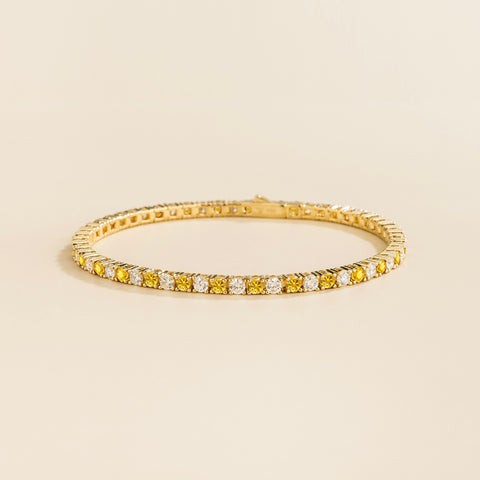
Common Mistakes Buyers Make and How to Avoid Them
Prioritising total carat weight over stone matching. A higher carat bracelet with inconsistent colour reads as amateur, not luxurious. Always assess stone matching across the full line before assessing size.
Ignoring clasp quality. The clasp is the most vulnerable point of any bracelet. Box clasps with safety catches are the standard for fine pieces. A cheap clasp on an expensive bracelet is a false economy.
Choosing metal by aesthetics alone. Lifestyle matters as much as looks. Platinum and 18ct gold outperform lower alloys in daily wear conditions, both in durability and in how they hold settings over time.
Overlooking sizing. A tennis bracelet should lie flat and move gently on the wrist. Too loose and it rotates constantly. Too tight and it digs in. Get measured.
Confusing lab-grown yellow sapphire with simulants. A lab-grown sapphire is a real sapphire. Cubic zirconia and nano crystals are not, and they show it quickly.
The Yellow Sapphire Bracelet Buying Checklist
Use this before you commit to any purchase:
- Purpose defined: daily wear, milestone gift, or special occasion?
- Style chosen: tennis, bangle, chain, or cuff?
- Colour quality assessed: vivid, consistent, free from undesirable undertones?
- Clarity confirmed: eye-clean across all bracelet stones?
- Carat weight proportional to wrist size?
- Setting appropriate to lifestyle: bezel or channel for active wear; prong for elegance?
- Metal selected for both durability and aesthetic intent?
- Origin understood: natural or lab-grown, honestly disclosed?
- Clasp quality verified: box clasp with safety catch recommended?
- Sizing confirmed: measured and properly fitted?
- Certified gemstones with full supporting documentation?
The Right Yellow Sapphire Bracelet Is the One That Fits Your Life
A yellow sapphire bracelet is not a trendy decision. It is an intentional one. The perfect bracelet is not the one with the highest carat weight or the lowest price. It is the one that fits your wrist, your wardrobe, your lifestyle, and your values.
Colour consistency, setting integrity, metal durability, and honest provenance: these are the criteria that separate a bracelet you will wear for a decade from one that disappoints within a season. You now have the framework to tell the difference.
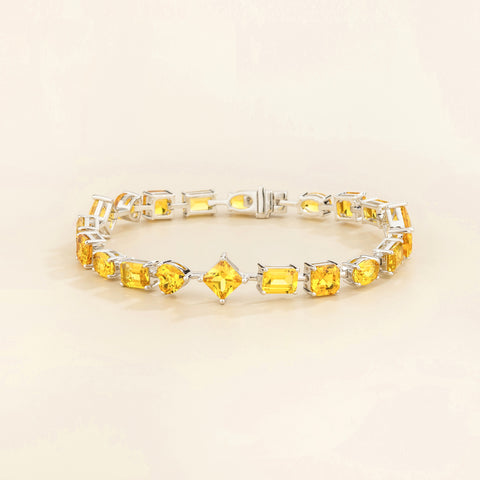
Explore Juvetti's collection of ethically crafted bracelets, designed for beauty, longevity, and the values that matter. Browse the complete collection to discover how beautifully these pieces work together across every jewellery category.

Frequently Asked Questions
Is a yellow sapphire tennis bracelet suitable for everyday wear?
Yes, with the right setting. Yellow sapphire ranks Mohs 9 on the hardness scale, making it one of the most durable coloured gemstones available. For daily wear, a bezel or channel-set tennis bracelet in 18ct gold or platinum offers the best combination of stone security and surface protection. A well-made yellow sapphire tennis bracelet will reward consistent wear with enduring beauty.
What is the best carat size for a yellow sapphire bracelet?
There is no single answer, because carat weight must be proportional to wrist size and bracelet style. For a tennis bracelet, a total carat weight of 3 to 8ct across the line is the practical range. Prioritise colour consistency and stone matching over raw carat size. A smaller, vivid, well-matched bracelet always outperforms a larger, inconsistent one.
Does lab-grown yellow sapphire look different from natural?
No, not to the naked eye, and not under standard gemological testing. Lab-grown yellow sapphires are chemically and optically identical to their natural counterparts. What lab-grown stones offer, particularly in bracelets, is superior colour and clarity consistency across multiple stones, a meaningful advantage in a piece where every stone is visible and compared.
What metal works best with yellow sapphire bracelets?
Yellow gold is the most natural partner, its warmth complementing the yellow sapphire's colour beautifully. 18ct yellow gold is the ideal daily-wear standard. White gold and platinum both create a striking contrast that makes the yellow sapphire appear more vivid. Rose gold pairs well with golden and champagne-toned stones. Platinum is the most durable choice for a bracelet intended for heavy daily use.
How do I know if a yellow sapphire bracelet is good quality?
Assess five things: colour consistency across every stone; clarity that is eye-clean at wrist distance; cut uniformity so stones sit flush and reflect light evenly; setting integrity with smooth prongs and even bezels; and clasp quality with a box clasp and safety catch. Request certification for the stones and full disclosure of any treatments.
Are yellow sapphire bracelets a good investment?
Fine yellow sapphire bracelets, particularly those using vivid-coloured stones in quality settings, hold their value well and can appreciate over time as demand for ethically sourced coloured gemstones grows. The most reliable investment logic, however, is personal value: buying something well-made, genuinely beautiful, and suited to your life. A piece you wear every day and care for properly is worth far more than any market calculation.