Pink Sapphire Earrings: The Complete Buying Guide
Nothing frames the face quite like earrings. They catch the light in conversation, draw the eye more than almost anything else you wear, and occupy a position no other piece of jewellery can. Pink sapphire adds something especially compelling to that role: a colour that flatters the skin, rather than simply decorating it.
Choosing pink sapphire earrings involves more decisions than most buyers expect. Colour tone, matching between the pair, cut, setting style, metal, and origin all play a part, and getting any one of them wrong is what leaves a beautiful pair sitting unworn in a drawer. None of these decisions is difficult once the logic behind them is understood, and this guide provides exactly that logic.
A few themes run through everything that follows. Pink sapphire has moved from an alternative choice to a mainstream fine jewellery staple, no longer a niche pick for buyers seeking something different. Pair matching matters more in earrings than in any other category of jewellery, for reasons the colour grading section explains in full. And the 2026 buyer has better options than ever before, particularly when it comes to lab-grown stones, with quality and consistency that simply were not available a decade ago.
By the end of this guide, you will know exactly which pink sapphire earrings suit your colouring, your lifestyle, and your budget, and how to judge quality with confidence the moment you see a pair.
Why Pink Sapphire Works So Well in Earrings
Colour on the Face
Earrings sit directly beside the skin of the face, closer to your complexion than any other piece of jewellery you wear. That proximity means the stone's colour interacts with skin tone in a way it simply does not with a ring or a bracelet.
Pink tones bring warmth to the face in a way white stones cannot, softening features and adding a natural flush of colour that colourless gems leave entirely to chance. This is a large part of why pink sapphire has become one of the most universally flattering earring stones available, working across a genuinely wide range of complexions rather than suiting only a narrow band of colouring. Different pink intensities suit different skin tones and hair colours in different ways, a subject the colour grading section below covers in full.

Durability Where It Matters
Pink sapphire sits at Mohs 9, just below diamond's 10, making it the second-hardest widely worn gemstone. In practical terms, this means earrings that survive daily wear, handbags, travel, and decades of use without losing their finish. Earrings face far fewer knocks than rings do; there is no door frame or worktop for an earring to catch against, the way a ring catches constantly through the day. That difference makes pink sapphire effectively worry-free at the ear, hard enough for genuine daily wear without the higher price tag that comes with diamonds' extra point of hardness.
The Symbolism Worth Wearing Daily
Pink sapphire carries associations of love, compassion, warmth and quiet strength, a symbolism gentler and more personal than diamond's language of permanence. Worn at the ear, close to every conversation you have, that meaning is present in a way it rarely is anywhere else on the body. What do you want the first thing people notice about you to say?
Pink Sapphire Colour Grading: From Light Pink to Hot Pink
Understanding colour is the single most useful skill a pink sapphire earring buyer can develop, and it deserves real depth here, because it drives nearly every other decision in this guide.
The Pink Sapphire Colour Spectrum
Light pink, or blush, is the most understated option on the spectrum. It reads as delicate and romantic, almost neutral at a distance, and suits buyers who want colour that is felt more than seen.
Rose, or medium pink, sits at the versatile centre of the range. It is clearly, confidently pink without tipping into statement territory, and it is the easiest tone to wear across every occasion, which is why it is the most common choice for a first pair.
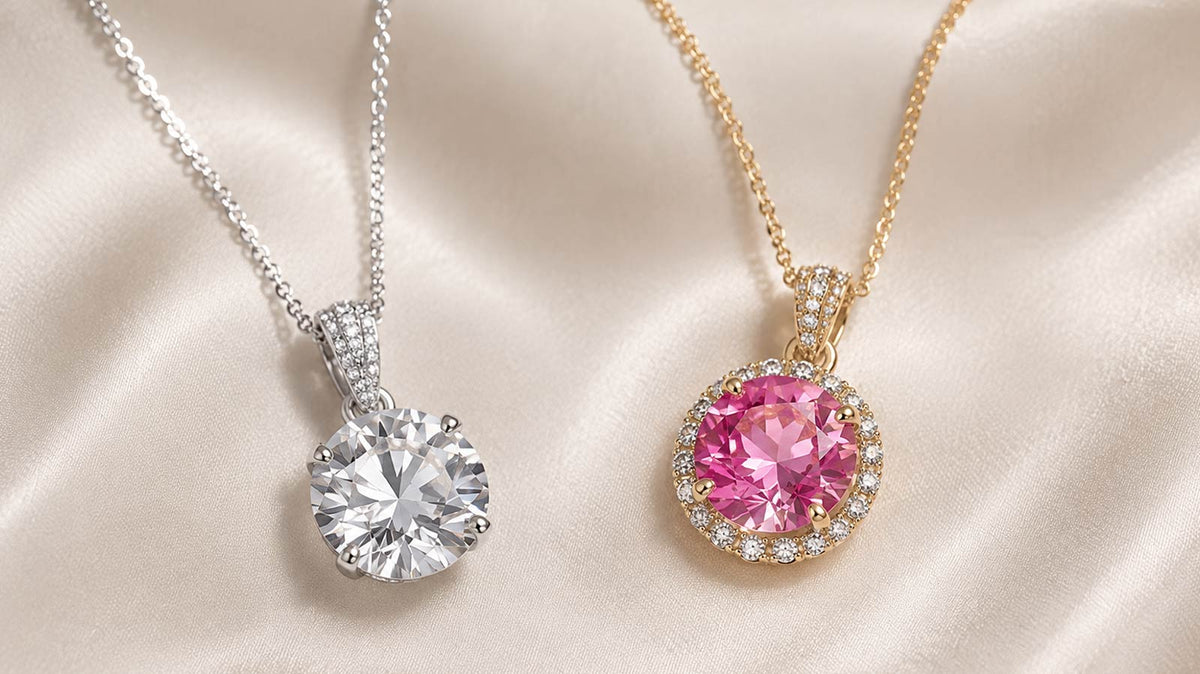
Hot pink, or vivid pink, is saturated and confident, the most desirable and most valuable tone in the spectrum. It is often marketed as "bubblegum" or "vivid," and it is the shade that makes pink sapphire earrings genuinely impossible to ignore.
Magenta, or purplish pink, is deep and dramatic, carrying a cooler undertone than the warmer pinks above it. It suits buyers drawn to jewellery with a moodier, more sophisticated edge.
A professional grading a pink sapphire actually assesses three separate components. Hue is the underlying colour family, whether the pink reads as pure or leans slightly purplish or orangish at the edges. Saturation is the intensity of that colour, and it is the primary driver of value across the entire spectrum. Tone is simply how light or dark the stone appears. Understanding these three factors separately, rather than judging "pink" as a single quality, is what separates a confident buyer from one relying on guesswork.

Light Pink vs Hot Pink: Which Should You Choose?
This is a genuine decision, not a question with a hedge for an answer. Light pink suits subtle daily elegance, professional settings, and buyers who want colour that whispers rather than announces itself; it is the safer choice for someone wearing their earrings into a boardroom five days a week. Hot pink suits presence, evening wear, and buyers who want the stone noticed the moment they walk into a room; it is worth stating plainly that vivid stones command meaningfully higher prices than paler tones of the same size.
Against skin, both tones perform differently depending on your undertone. Warmer, deeper skin tones tend to carry vivid hot pink beautifully, with the saturation reading as rich rather than overpowering. Lighter or cooler skin tones often find blush and rose tones the most naturally flattering, with hot pink still wearable but requiring a bit more confidence to pull off. Hair colour plays a role too: warmer, golden-toned hair pairs particularly well with rose and hot pink, while cooler, ash-toned hair often suits the softer end of the spectrum. Do you want your earrings to blend into your look, or to lead it?

Why Colour Matching Between the Pair Is Everything
This is the earring-specific quality rule most buyers have genuinely never considered before shopping for a pair. Earrings are two stones, worn symmetrically, viewed at eye level in nearly every social interaction you have. Even slight mismatches in hue or saturation between the left and right stone are immediately noticeable in earrings, in a way that would be entirely invisible in a cluster piece or a multi-stone necklace, where the eye reads colour as an overall impression rather than a direct comparison.
This is exactly why properly matched pairs command a premium over two individual stones of the same nominal grade; sourcing two natural stones that are truly identical in hue, saturation, and tone is a genuinely difficult and time-consuming task. It is also exactly where lab-grown production changes the equation entirely, a subject covered in full below.
Natural vs Lab-Grown Pink Sapphire Earrings
This comparison deserves confidence and balance in equal measure. Lab-grown is genuinely the premium ethical choice for most buyers, but that does not mean natural stones should be dismissed.
What Lab-Grown Actually Means
Lab-grown pink sapphires share the same chemical composition, Mohs hardness of 9, and optical properties as natural stones. Chemically, both are corundum; the only difference is where and how the crystal formed. They are real sapphires and should never be confused with simulants such as cubic zirconia or nanocrystals, materials which share none of corundum's physical or optical properties and behave completely differently over years of wear. Juvetti's lab-grown gemstones are produced sustainably and set in recycled gold and silver, a values-led approach that runs through the whole collection rather than being reserved for a single product line.
Where Natural and Lab-Grown Differ for an Earring Buyer
Four practical differences matter most when you are buying for the ear specifically. Pair matching is the single biggest advantage lab-grown offers earring buyers: because the growing process can be controlled precisely, lab-grown pairs can be matched to an almost perfect degree of consistency, something exceptionally difficult and expensive to achieve with two natural stones.
Traceability and ethics favour lab-grown decisively, giving the conscious buyer full provenance rather than a supply chain that can be genuinely hard to verify. Value tips clearly towards lab-grown too, delivering larger or more vivid stones within the same budget. Treatment transparency deserves a plain, unapologetic statement: natural pink sapphires are very commonly heat-treated to improve colour and clarity, and this is a normal, accepted, and stable part of the trade, not something to be concerned about, provided the seller discloses it honestly.
Which Is Right for You?
This is a question of values and priorities, not a quality hierarchy with a right answer. Is the story behind your jewellery as important to you as the stone itself? For buyers who answer yes, lab-grown is the natural fit. For buyers drawn to the idea of a stone formed over millions of years, a fine natural pair remains a beautiful, entirely valid choice. Juvetti's pink sapphire earrings collection is built primarily around lab-grown stones for exactly the reasons above, matched with the same craftsmanship that its origin deserves.

The Best Cuts for Pink Sapphire Earrings
Every cut here is assessed for how it performs specifically at the ear, not in the abstract. A cut that suits a large statement ring does not automatically suit a stud worn eight hours a day.
Round Brilliant
Round brilliant is the benchmark cut for studs. It delivers maximum light return, looks symmetrical from every angle, including the side profiles other people actually see in conversation, and never looks dated. It is the safest choice for a first pair, and the standard against which every classic solitaire stud is measured.
Oval and Pear
Ovals and pears are the natural choices for drop earrings, their elongated shape following the line of the drop and visually lengthening the neck as they fall. Pear, worn point down, is the signature drop-earring silhouette for good reason: its tapering shape catches and releases light differently as it swings, giving drop earrings the sense of movement that makes them worth choosing over a stud in the first place.

Cushion and Princess
The cushion cut brings a soft, vintage-leaning romance that suits halo settings particularly well, with its rounded corners softening the overall look. Princess cut offers modern geometry and works best in clean, contemporary stud settings. One practical note: princess cuts' sharp corners are more vulnerable to chipping than rounded cuts, so they benefit from a protective setting, a point the settings section below picks up on in more detail.
Cut Quality: What Actually Matters at the Ear
Two flaws account for most disappointing pink sapphires, and both come down to proportion. Windowing happens when a stone is cut too shallow, creating a washed-out, colourless patch at the centre where light passes straight through instead of reflecting back to the eye; it is the single most common cut flaw in coloured stones, and it is often invisible until you compare a well-cut and poorly cut stone side by side. Extinction is the opposite problem, where a stone cut too deep traps and darkens light, leaving dead-looking dark zones. A well-cut smaller stone will consistently outperform a poorly cut larger one in appearance on the ear. In pink sapphire, specifically, cut quality is colour quality: the cut determines how much of the stone's colour reaches your eye, making it arguably more important here than in a colourless diamond.
Settings and Styles: Studs, Drops and Hoops
Pink Sapphire Stud Earrings
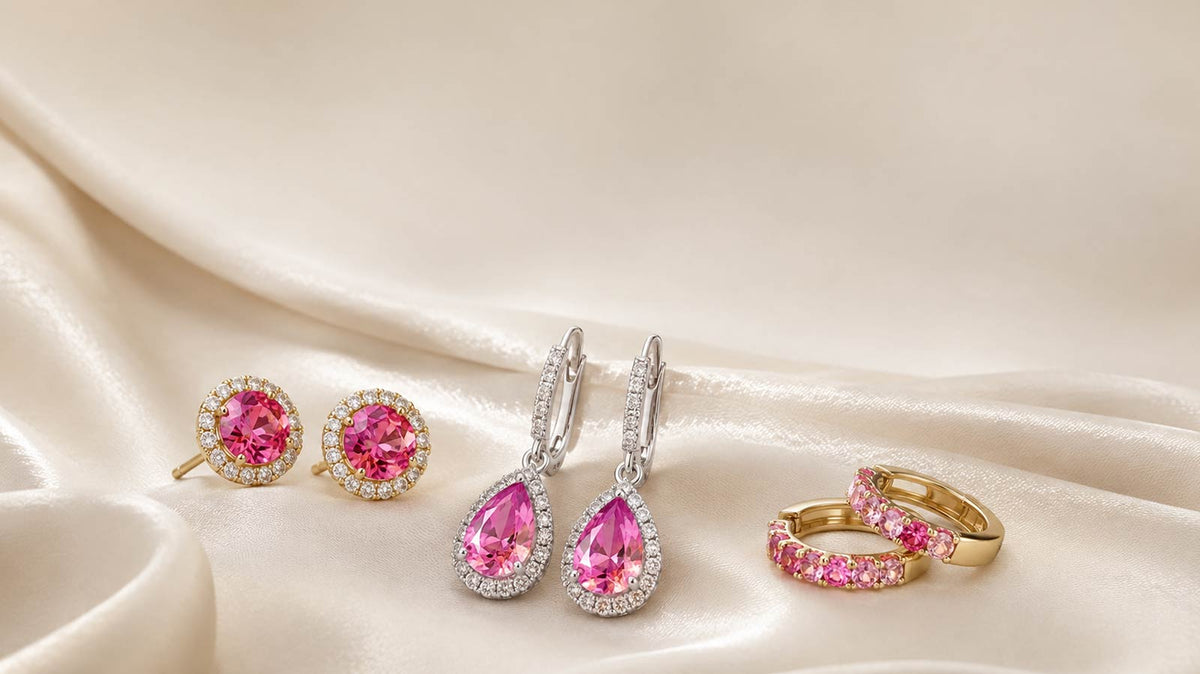
Studs are the everyday foundation of a jewellery wardrobe, the pair reached for without a second thought most mornings. Solitaire studs put the stone's colour and cut on full, uninterrupted display; halo studs surround the centre stone with a ring of diamonds, adding perceived size and a layer of diamond sparkle around the pink.
For security at the ear, claw settings expose more of the stone's colour but leave slightly more of the girdle vulnerable, while bezel settings wrap the stone in a protective rim of metal, trading a small amount of visible colour for meaningfully better protection during active days. Studs suit the daily-wear buyer, the professional who wants colour without distraction, and the first-time pink sapphire owner easing into the stone.

Pink Sapphire Drop and Dangle Earrings
Movement is the defining quality of a drop earring, colour that swings and catches light with every turn of the head rather than sitting static. Short drops offer everyday versatility, subtle enough for daytime while still bringing more presence than a stud. Statement chandeliers are built for occasions, evenings, and events where the earring is meant to be noticed from across a room. Drops pair naturally with a coordinating necklace; readers building a full look may want to consider Juvetti's pink sapphire necklace collection alongside their earring choice. Drops suit the occasion dresser and the romantic at heart.

Pink Sapphire Hoop Earrings
The gemstone hoop has seen a genuine modern revival, and pink sapphire suits the trend particularly well. Pavé-set hoops, lined with small pink sapphires along the band, offer continuous, all-around colour and sparkle. Charm-style hoops, a plain hoop with a pink sapphire drop or charm hanging from it, offer a more casual, layered look.
Huggie hoops sit as the everyday middle ground between a stud and a full drop, close to the ear and easy to wear from morning to night. Hoops suit the contemporary buyer who wants colour with a more informal, current edge than a classic stud offers.

Secure Fittings: The Detail Buyers Forget
The back of an earring rarely gets the attention it deserves, yet it is the detail that determines whether a beautiful pair stays with you for decades or is lost within a year. Butterfly backs are the standard, lightweight and easy to use, well suited to studs worn daily where quick removal matters. Screw backs offer more security and are worth the extra step for heavier studs or for anyone prone to catching an earring on scarves or hair.
Lever backs are built specifically for drop and dangle earrings; their hinged closure holds the earring securely in place during movement in a way a simple post cannot. Match the fitting to the style rather than defaulting to whatever a piece happens to arrive with; this small detail signals real expertise in a jeweller, and it is worth asking about specifically before you buy.
Metal Choice: What Frames Pink Sapphire Best
Gold Colour: White, Yellow or Rose
The metal a pink sapphire sits in changes the character of the stone as much as the stone's own colour does. White gold and platinum cool and intensify pink through contrast, making the colour read as more vivid and contemporary. Yellow gold warms the pairing into a vintage richness, softening the pink to something closer to dusty rose, regardless of the stone's actual saturation. Rose gold creates a tonal, romantic blend, letting metal and stone colour flow into one another rather than contrast. For readers weighing this decision in more depth, Juvetti's white gold vs yellow gold vs rose gold guide covers every dimension of the choice.
Gold Purity: 14K vs 18K at the Ear
The practical trade-off here is straightforward. 18K gold delivers richer colour and higher purity, a deeper, more luxurious tone against the pink sapphire. 14K gold delivers greater hardness and better value, holding up to daily contact with less risk of surface wear over years of use. This matters more for earring posts than buyers often expect, since posts and backs are handled repeatedly every time the earrings go in and out. For the full breakdown of how the two purities compare, see Juvetti's dedicated 14K vs 18K gold guide.
Platinum and Sensitive Ears
Platinum deserves its own mention here, particularly for a segment of earring buyers who are often underserved by general jewellery advice. It is naturally hypoallergenic, dense, and exceptionally durable, making it a genuine heirloom-quality choice for a pair meant to last generations. It is also worth a brief, practical note on nickel sensitivity: some white gold alloys contain nickel, which can cause reactions in sensitive ears over time, whereas platinum and nickel-free white gold alloys avoid this issue entirely. If you have experienced irritation from earrings before, this is worth raising directly with your jeweller before you buy.
Pink Sapphire Earring Pricing: What to Expect in 2026
The Pricing Tiers
At the entry level, roughly £250 to £700, you will find smaller stones, lighter pink tones, and simple stud settings; these make excellent first pieces and a low-risk way to discover whether pink sapphire suits you before committing to more.
In the mid-range, roughly £700 to £2,000, expect vivid colour, properly matched pairs, halo and drop designs, and 18K settings; this is where most considered, long-term purchases sit.
At the fine and bespoke level, £2,000 upwards, you are paying for exceptional saturation, larger matched pairs, diamond-set designs, and genuinely custom work built around your exact specifications.
These tiers are the map rather than the full journey. For a complete breakdown of what each price band actually buys, and why two similar-looking pairs can sit hundreds of pounds apart, see Juvetti's dedicated pink sapphire earrings price guide.
What Actually Drives the Price
Several factors combine to determine the price of any pair, and understanding them helps prevent overpaying for the wrong one. Colour saturation is the dominant driver across the entire market. Pair-matching precision adds real value once you move past entry-level pieces. Carat weight per stone matters, though less than saturation. Cut quality affects how much of that colour and weight you actually see. Natural versus lab-grown origin shifts price significantly at the same visual quality. Metal and setting complexity add cost through craftsmanship and materials. Diamond accents, where present, incur an additional cost on top of the centre stones.
Buying Smart: Where Value Lives
The smartest money in this category rarely goes to the largest stone. A vivid lab-grown pair consistently outperforms paler natural stones at the same price point, delivering more visible colour and better pair matching for the pound. As a general rule, saturation beats size at the ear: a smaller, richly coloured stone reads as more valuable and more striking than a larger, washed-out one, every time. For readers thinking beyond the purchase itself and toward long-term value retention, Juvetti's article on pink sapphire value and investment provides a more in-depth, honest picture.
Who Are Pink Sapphire Earrings For?
The daily-wear devotee reaches for studs, in a claw or halo setting, chosen for comfort and colour that works with everything in the wardrobe. The milestone gifter looks to drops, presentation-ready and a little more considered, marking an anniversary, a birthday, or a graduation with something that will be remembered. The self-purchaser buys to mark their own achievement, often gravitating toward a bolder tone than they would choose as a gift for someone else. The collector builds towards a matched set across earrings, a ring, and a necklace over time; Juvetti's pink sapphire rings collection is the natural next step for anyone building a coordinated look.
Common Mistakes When Buying Pink Sapphire Earrings
Ignoring pair matching and judging each stone individually. A mismatched pair reads as a flaw the moment both earrings are actually worn together, no matter how good either stone looks alone.
Choosing size over saturation. A large, pale stone impresses far less at the ear than a smaller, vivid one; colour is what the eye actually registers first.
Overlooking the fitting. A beautiful earring with an insecure back is a loss waiting to happen, and it is one of the most preventable disappointments in fine jewellery.
Confusing lab-grown with simulants. Lab-grown pink sapphire is real sapphire; cubic zirconia is not, and the difference in hardness and wear shows within months, not years.
Buying without treatment disclosure or certification. Reputable sellers state origin and treatment plainly, without being asked twice; if that information is not offered upfront, ask for it before you buy.
The Pink Sapphire Earrings Buying Checklist
- Colour tone chosen: light pink, rose, hot pink or magenta?
- Pair matching confirmed: identical hue and saturation across both stones?
- Cut assessed: no windowing, strong colour return face-up?
- Style selected: studs, drops or hoops, matched to your lifestyle?
- Fitting secure: backs appropriate to the style and the wearer?
- Metal chosen for both colour effect and durability: 14K, 18K or platinum?
- Origin understood: natural or lab-grown, honestly disclosed?
- Treatment disclosed and certification provided?
- Is the budget aligned to the tier that meets your purpose?
The Confidence to Choose
The perfect pair of pink sapphire earrings is a matter of understanding, not luck. Colour tone, pair matching, cut, setting and metal each follow a clear logic, and the buyer who understands that logic chooses once and enjoys the choice for decades rather than second-guessing it. Pink sapphire earrings are a rare kind of purchase: personal, practical, and enduring, all at once.
Explore Juvetti's collection of ethically crafted pink sapphire earrings, designed in London with lab-grown stones and recycled metals, reflecting the values modern buyers care about.
Frequently Asked Questions
What colour pink sapphire is most valuable in earrings?
Vivid, saturated hot pink or "bubblegum" pink commands the highest value, driven primarily by colour intensity rather than size. Pure pink hues, without strong purplish or orangish secondary tones, are valued above modifying colours. Lighter blush and rose tones remain popular and are typically more affordable, offering excellent value for buyers who prefer a subtler look.
Are pink sapphire earrings suitable for everyday wear?
Yes. At Mohs 9, pink sapphire is the second-hardest widely worn gemstone, and earrings face far fewer daily knocks than rings do. A well-set pink sapphire stud or huggie hoop can genuinely be worn every day for decades with only routine care and no meaningful risk to the stone.
How much do good pink sapphire earrings cost?
Entry-level pairs start around £250 to £700, with mid-range pieces featuring vivid colour and matched pairs running roughly £700 to £2,000. Fine and bespoke pairs, with exceptional saturation and diamond accents, start from around £2,000. Colour saturation and pair matching precision are the biggest drivers of price within any tier.
Do lab-grown pink sapphire earrings look different from natural ones?
No. Lab-grown pink sapphire shares identical chemical composition, hardness, and optical properties with natural sapphire, and the two are visually indistinguishable to the naked eye. The main practical difference for earring buyers is that lab-grown stones can be matched between the pair with far greater precision than natural stones typically allow.
What metal looks best with pink sapphire earrings?
White gold and platinum cool and intensify the pink through contrast, giving a contemporary look. Yellow gold warms the pairing lending it a vintage richness. Rose gold blends tonally with the stone for a soft, romantic effect. There is no single correct answer; the right metal depends on your existing jewellery and the effect you want.
Are pink sapphire stud earrings a good gift?
Yes, particularly for buyers who want a gift that feels considered without being overstated. Pink sapphire's symbolism of love, compassion, and quiet strength suits sentimental occasions well, and studs in particular work across nearly any recipient's personal style, making them a genuinely safe yet meaningful choice.