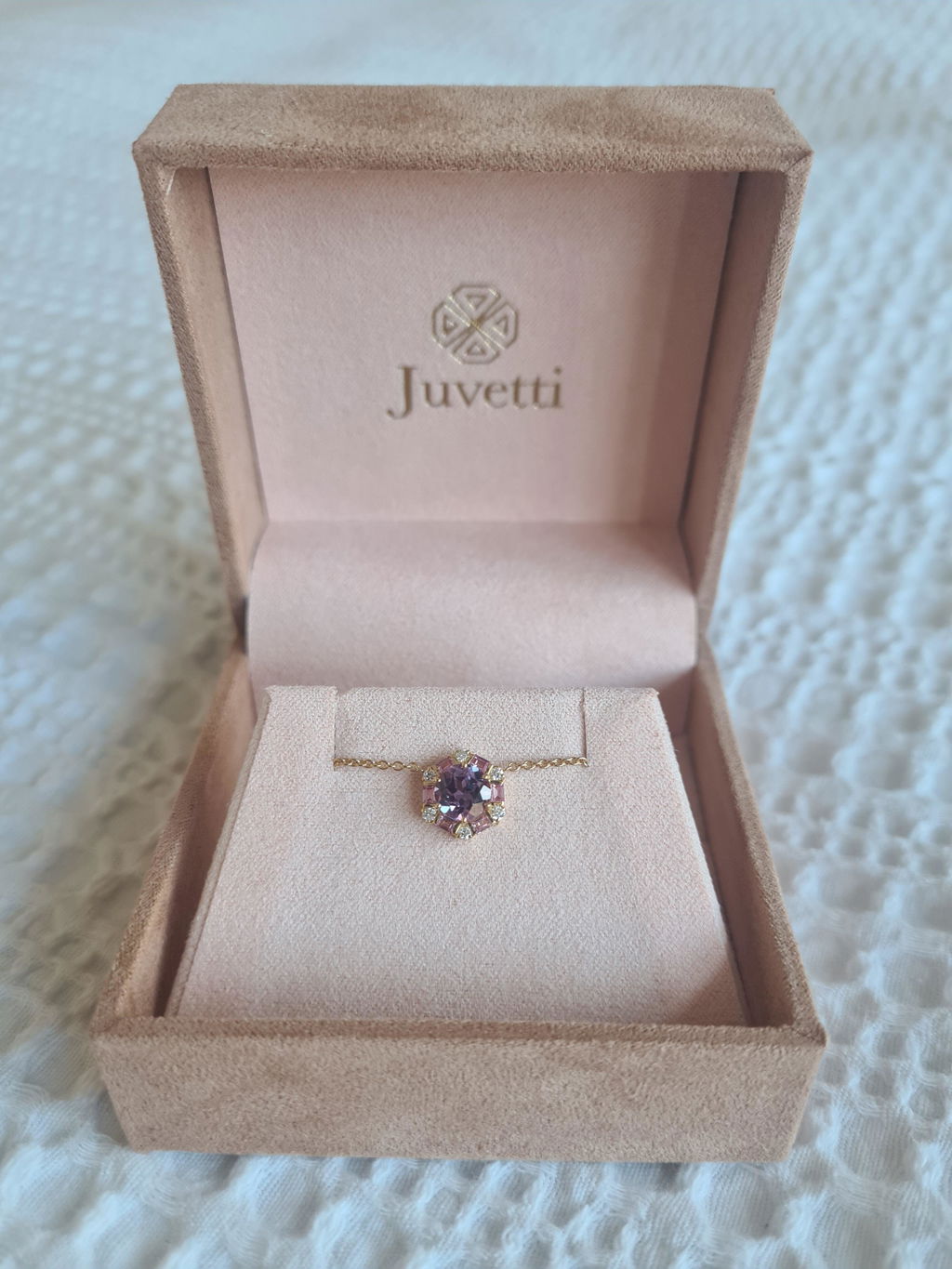
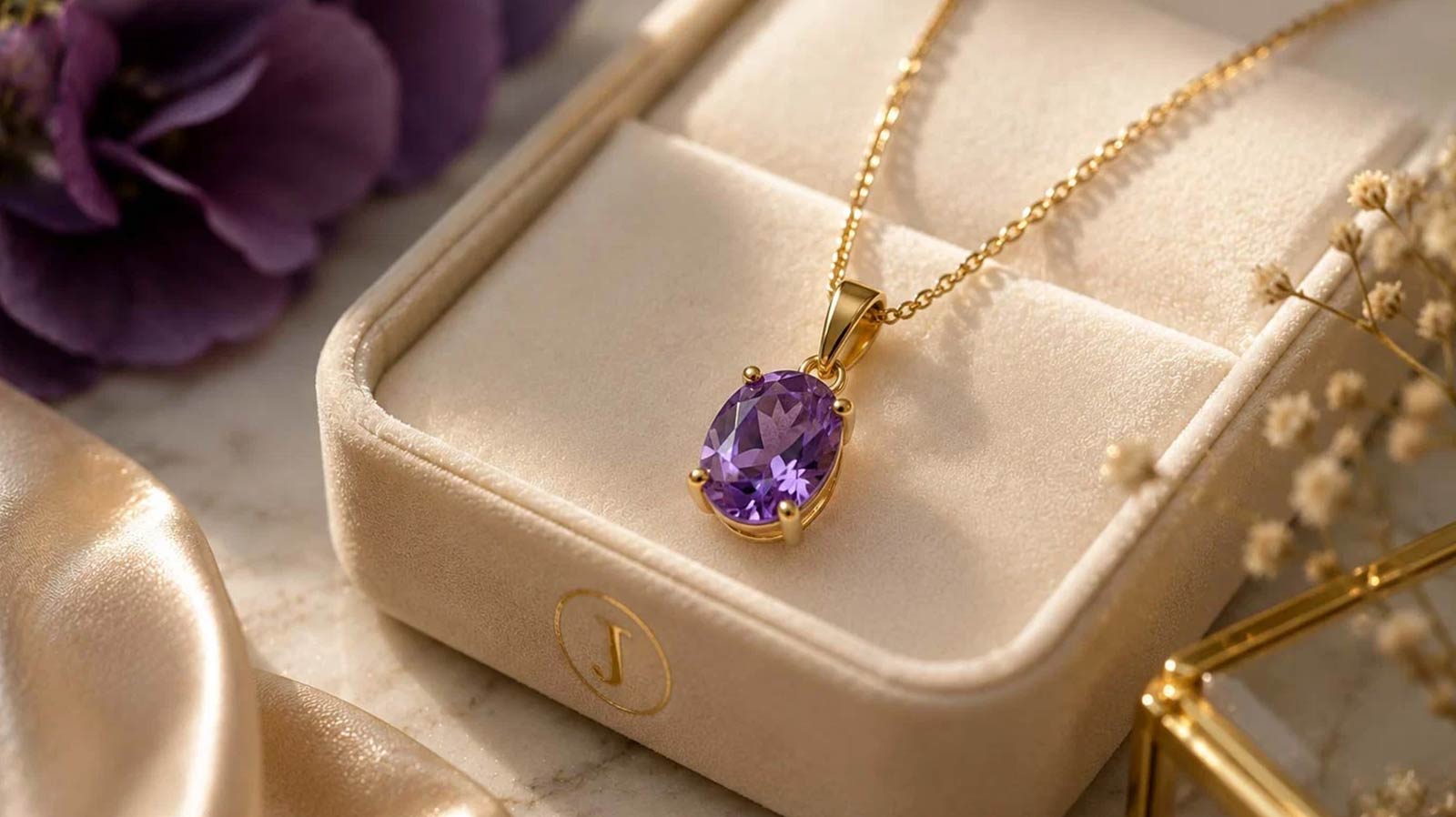
Purple Sapphire Necklace Buying Guide | Juvetti London
Choosing a purple sapphire necklace comes down to a handful of decisions made in the right order: a shade of purple you enjoy in every kind of light, a lively and well-cut stone, clarity that looks clean to the naked eye, honest disclosure of origin, a necklace style suited to how often you will wear it, a metal that flatters both the stone and your skin, and a price explained by materials and craftsmanship rather than guesswork. This guide works through each decision with current UK prices and real examples from Juvetti, a London jeweller specialising in fine jewellery made with lab-grown precious gemstones and recycled gold.
Last reviewed: 27 July 2026. All prices were checked on Juvetti's UK storefront at the time of writing.
At a glance: what matters most
- Colour first. Hue, tone and saturation decide beauty far more than carat weight.
- Cut second. A well-cut sapphire looks alive; a poorly cut one looks flat or inky.
- Eye-clean clarity is the practical standard, not microscopic perfection.
- Origin disclosure. Know if the stone is natural, treated or lab-grown before you pay.
- Metal and purity change the price as much as the gemstone does.
Contents
- How to choose a purple sapphire necklace
- How purple sapphire colour is assessed
- What clarity should you expect?
- Why cut matters as much as carat weight
- Lab-grown vs natural purple sapphire
- Purple sapphire vs amethyst
- Which necklace style should you choose?
- Which gold colour looks best?
- Solid gold, gold purity and gold vermeil
- UK prices
- How to judge a necklace online
- Buying checklist
- FAQs
How to Choose a Purple Sapphire Necklace
Six steps keep the decision manageable.
Step 1: set a budget range, not a single figure. UK purple sapphire pendants run from around £220 in gold vermeil to several thousand pounds for a solid gold tennis necklace.
Step 2: choose your shade family. Lavender, violet, rich purple or plum. This choice shapes everything else.
Step 3: pick a style. Solitaire, drop, halo, flower, clover or tennis. Style sets the presence of the piece and much of the price.
Step 4: choose a metal colour that suits your shade and the jewellery you already wear.
Step 5: decide between gold vermeil and solid gold, then a purity if you go solid.
Step 6: verify the details. Millimetre dimensions, chain length, origin disclosure, returns and warranty.
Quick Decision Table: Where to Start
Browsing a well-organised purple sapphire necklace collection early on helps you calibrate quickly, because you see the same shade across different cuts, settings and metals rather than judging one photograph in isolation.
How Purple Sapphire Colour Is Assessed
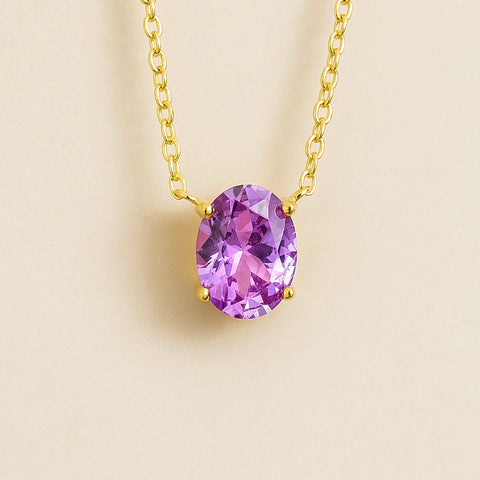
Gemmologists describe colour through hue (the basic colour and its secondary tints), tone (how light or dark it is) and saturation (how strong the colour appears). The Gemological Institute of America places purple sapphire in a range from reddish purple through to violetish purple. There is no universal, diamond-style grading scale for purple sapphire colour, so terms such as "royal purple" are retail descriptions rather than laboratory grades.
Two behaviours explain why the same stone photographs differently from different angles. Colour zoning means colour sits in bands; a well-oriented cut hides it face-up. Pleochroism means corundum can show slightly different colours from different directions, which is why a swinging pendant can flash between violet and purple. Lighting matters too: many purple sapphires appear cooler or more violet in daylight and warmer under some indoor lighting, although the result depends on the individual stone and the light source, so judge images taken in more than one setting.
Lavender and Pale Lilac
Light in tone and soft in saturation, lavender reads as subtle and modern, suits everyday wear next to the skin and flatters minimal wardrobes. Pale stones let light pass through easily, so inclusions and windows show more readily; clarity and cut deserve extra scrutiny here.
Medium Violet and Balanced Purple
The most versatile family: enough colour to read clearly as purple across a room, enough light return to sparkle. A medium violet-purple with strong saturation is a versatile choice, particularly when buying for someone else.
Deep and Highly Saturated Purple
Rich purple has real presence, particularly in larger cuts, but darker does not automatically mean better. A stone that is too dark loses visible colour indoors and can read as near-black. Look for depth with life still moving through the stone.
Plum, Pinkish Purple and Blue-Violet Tones
Purple sits between red and blue, and individual stones lean one way or the other. Plum and pinkish purples feel warmer and sit naturally with rose gold; blue-violet stones feel cooler and pair well with white gold and diamonds. Neither direction is a defect; it is a matter of taste and of the metal you plan to set against it.
What Clarity Should You Expect From a Purple Sapphire?
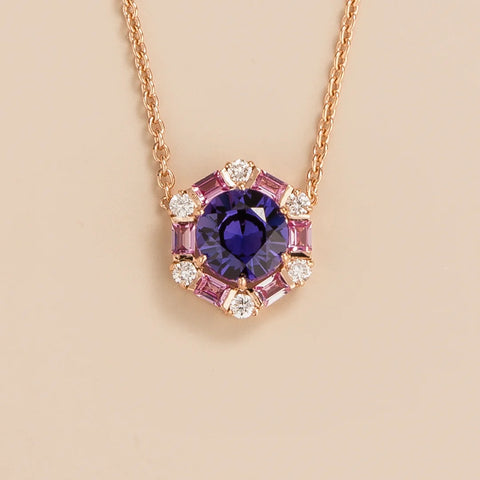
Judge coloured sapphire clarity by eye, not by diamond rules. GIA notes that coloured sapphires typically contain some inclusions, and completely clean natural stones are rare. The practical standard is eye-clean: nothing visible at normal wearing distance.
Small internal crystals visible only under magnification should not concern you. What should: visible cloudiness that dulls the stone, surface-reaching fractures or cavities, obvious dark patches, a washed-out centre, or abraded facet edges on a stone sold as new. Pale lavender stones show inclusions more readily; very dark stones hide them but may hide their own colour too.
Lab-grown sapphires are typically cleaner than natural material at the same price, but they are not automatically flawless, so the same eye-clean test applies.
Why Cut Matters as Much as Carat Weight
Cut controls how much light returns to your eye and how evenly the colour spreads. Two faults are worth learning to spot. A window is a pale, see-through patch in the centre where light passes straight through instead of reflecting back. Extinction is the opposite: large dark areas that stay dark as the stone moves.
Carat weight tells you less than you might expect, because weight hides in depth. Compare face-up millimetre dimensions rather than carats alone. Ovals and pears look larger than rounds of the same weight; emerald cuts trade sparkle for a clean geometric flash and make clarity easier to see, so they demand a cleaner stone. A diamond halo, meanwhile, enlarges the face-up footprint of a pendant without the cost of a much larger centre stone.
Lab-Grown vs Natural Purple Sapphire
Both are sapphire: the mineral corundum, aluminium oxide coloured by trace elements. A lab-grown sapphire shares essentially the same chemical, physical and optical properties as a natural one; the honest difference is origin. One crystallised in the ground over geological time, the other in controlled laboratory conditions. Lab-grown sapphire is not a simulant like cubic zirconia; it is the same material as mined sapphire. Fine natural purple sapphire is scarce, and natural stones are commonly heat treated to improve colour, which reputable sellers must disclose.
| Consideration | Lab-grown purple sapphire | Natural purple sapphire | What it means for the buyer |
|---|---|---|---|
| Material | Corundum, Mohs 9 | Corundum, Mohs 9 | Same inherent hardness and broadly comparable wear; an individual stone's durability still depends on its inclusions, treatments, cut and setting |
| Origin | Grown in controlled lab conditions | Formed geologically, then mined | A question of values and budget, not beauty |
| Colour | Consistent, strong saturation achievable | Fine colour is scarce; wide variation | Lab-grown makes matched, vivid stones practical |
| Clarity | Typically eye-clean | Often included; clean stones command premiums | Inspect either by eye and video |
| Treatments | Often grown to achieve the intended colour, although post-growth treatment is possible and should still be disclosed | Heat treatment common; must be disclosed | Always ask what has been done to the stone |
| Price | A fraction of comparable natural colour | Rises steeply with size and quality | Lab-grown buys bigger, better colour per pound |
| Rarity and provenance | Reproducible | Genuinely rare; origin can add value | Collectors may prefer natural |
| Mining | Can reduce reliance on newly mined stones | Depends on mining supply chains | Relevant if traceability matters to you |
| Best suited to | Colour-led buyers, larger looks, multi-stone designs | Collectors and provenance-led buyers | Both are real sapphire |
Natural stones suit buyers who value geological rarity and provenance. Lab-grown stones suit buyers who want strong colour, clean stones and larger designs within a workable budget, with origin disclosed plainly. Juvetti works exclusively with lab-grown sapphires, which is what makes multi-stone pieces such as tennis necklaces achievable at fine-jewellery prices.
Purple Sapphire vs Amethyst: Which Makes the Better Necklace?
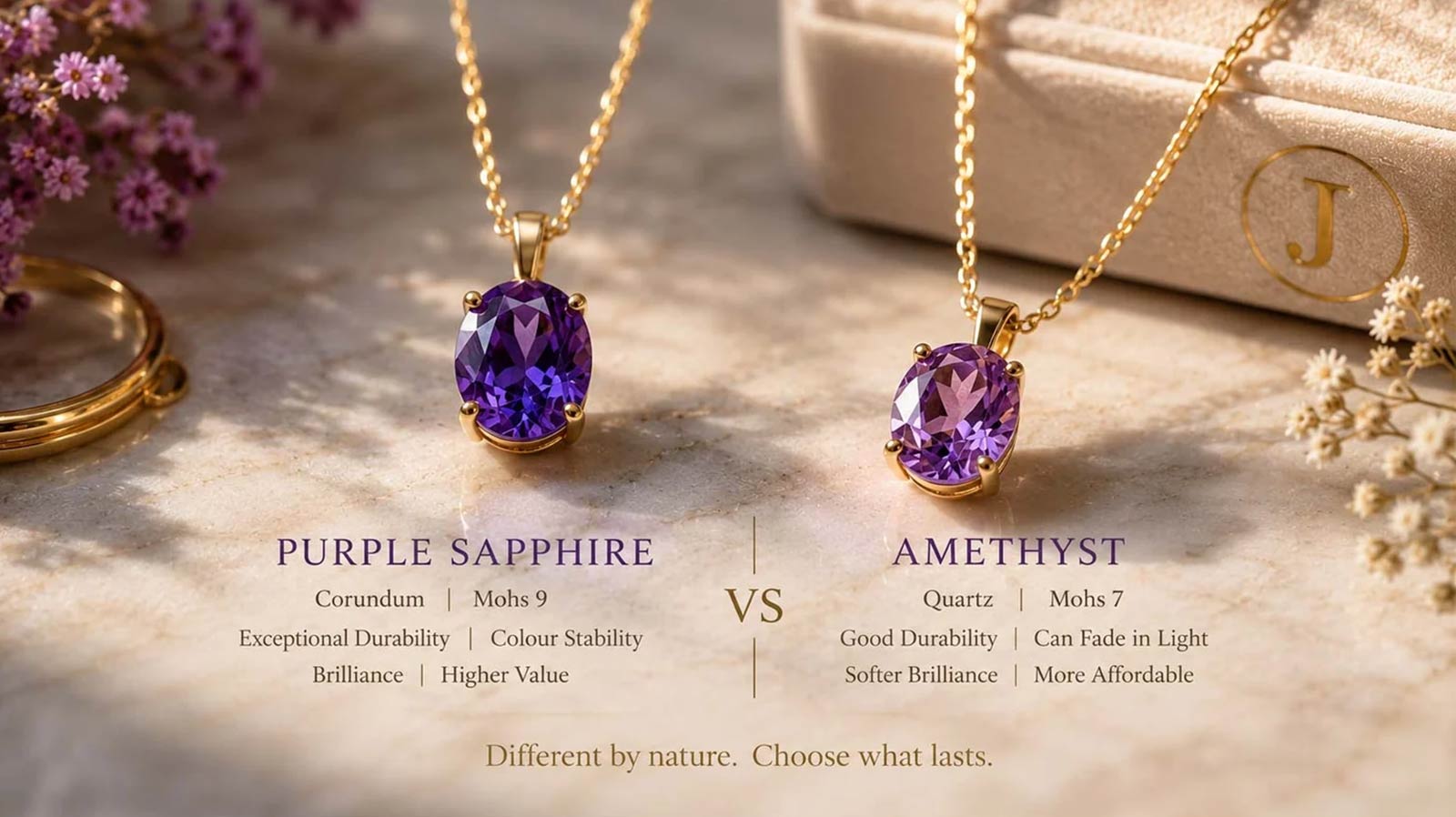
Buyers researching a purple gemstone necklace usually weigh these two stones, and the honest answer is that they serve different priorities. Amethyst is purple quartz, measuring 7 on the Mohs scale against sapphire's 9, and it is normally considerably more affordable, which makes it a sensible choice for someone prioritising a larger purple stone at a lower price. Purple sapphire's greater hardness and higher refractive index mean it resists surface wear better and typically produces stronger brilliance, which suits a necklace intended for frequent wear over many years. Neither is universally better; the decision rests on durability, appearance and budget.
| Consideration | Purple sapphire | Amethyst |
|---|---|---|
| Hardness | Mohs 9, highly scratch-resistant | Mohs 7, scratches more readily over time |
| Price | Higher, especially natural | Considerably more affordable |
| Appearance over time | Holds polish and brilliance with frequent wear | Softer surface can dull with heavy use |
| Best suited to | Long-term, frequently worn fine jewellery | Larger stones on a smaller budget, occasional wear |
Here you can check our complete purple sapphire vs amethyst comparison article.
Which Purple Sapphire Necklace Style Should You Choose?
Solitaire pendant. One stone, minimal metal, maximum versatility. Juvetti's Ovo oval solitaire carries an 8x6mm sapphire of about 1.55 carats, a sensible scale for daily wear that still reads clearly as purple. The easiest gift to get right.
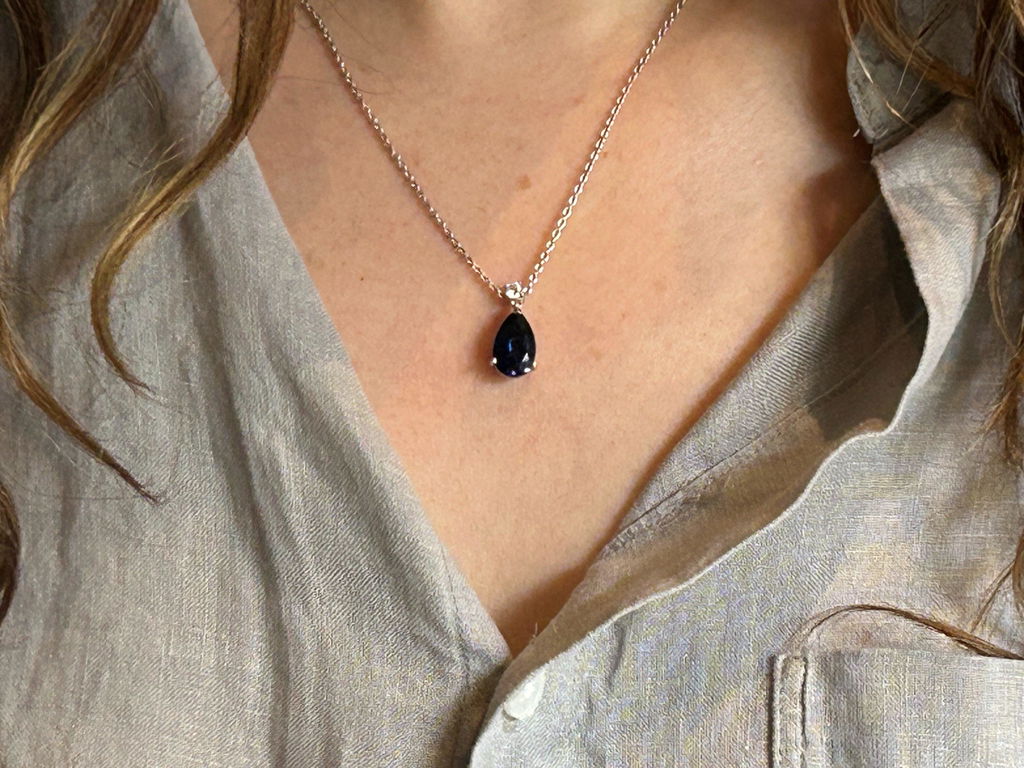
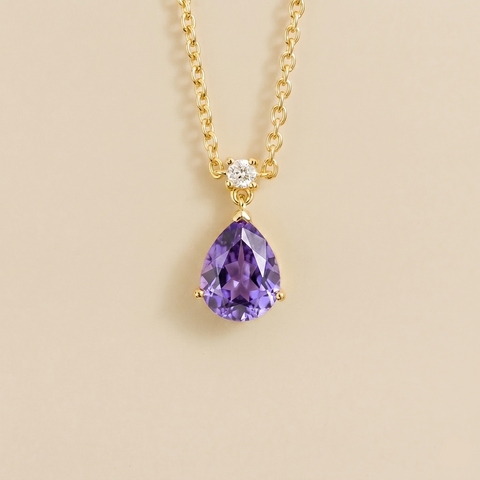
Pear-drop pendant. The tapered point draws the eye downward and flatters the neckline. The Ori pendant pairs a 9x7mm pear of around 2.22 carats with a small accent diamond, gaining presence without a halo.
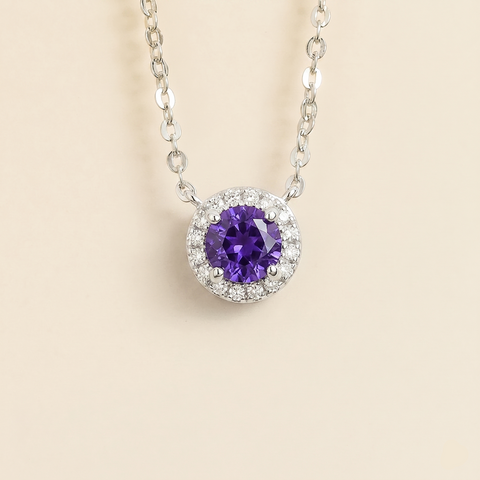
Diamond halo. A ring of small diamonds enlarges the face-up look and adds sparkle. The Mars pendant sets a 5mm round sapphire within D-F colour, VS-clarity diamonds, a compact piece that behaves like a larger one in evening light.
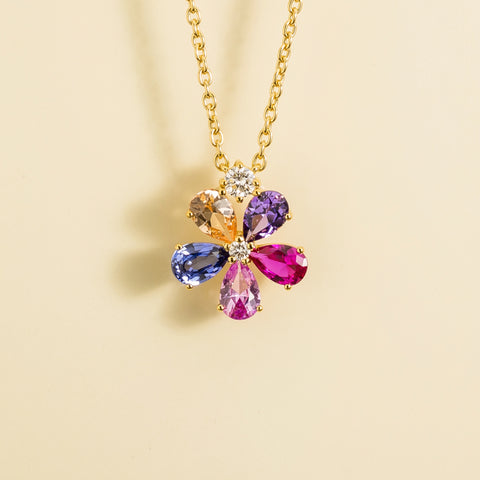
Flower, cluster and clover designs. Several stones arranged decoratively, sometimes mixing purple with pink, blue or champagne sapphires. Personality pieces, and ones that benefit greatly from the colour consistency of lab-grown stones.
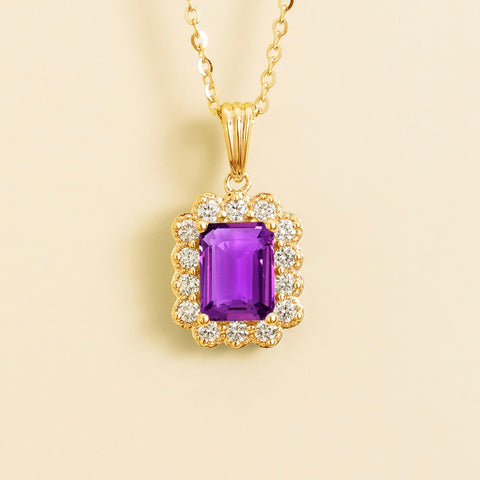
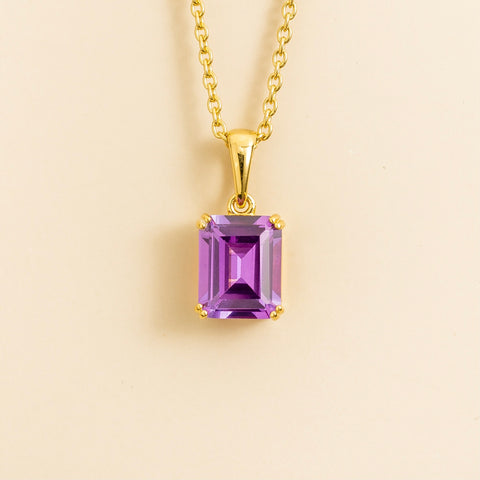
Emerald-cut statement pendant. The Thamani pendant carries a 10x8mm emerald-cut sapphire of roughly 4 carats: clean lines and a deliberately architectural look for buyers who prefer geometry to sparkle.
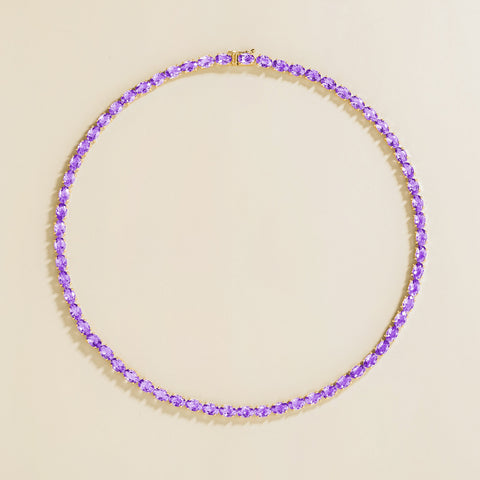
Tennis necklace. A continuous line of matched sapphires around the whole neck, the statement end of the category. The Salto tennis necklace carries around 18 carats of matched ovals; sourcing that many closely matched natural purple sapphires would normally be substantially more difficult and expensive.
If you may add matching earrings, a ring or a bracelet later, choose from a purple sapphire jewellery collection that carries the same stones across every category, so pieces bought years apart still agree with each other. A pendant you reach for several times a week also earns its price in a way an occasional piece never does, which is why a purple sapphire necklace can become a lasting investment piece in the wardrobe sense: an enduring, frequently worn part of your collection rather than a financial instrument.
Which Gold Colour Looks Best With Purple Sapphire?
These are tendencies rather than rules; all three metals work with purple.
Yellow gold sits opposite purple's cool side, creating warm contrast that makes violet and richly saturated stones appear deeper. Traditional, and the most distinctive against dark clothing.
White gold gives a cool, crisp frame that emphasises blue-violet tones and merges seamlessly with diamond halos, so the eye reads stone and diamonds as one bright object.
Rose gold flatters plum, pinkish and lavender stones by echoing their warmth. The most personal-looking choice, and the least common.
If you wear one metal daily, match it: a necklace that agrees with your existing jewellery gets worn.
Solid Gold, Gold Purity and Gold Vermeil
Most Juvetti purple sapphire necklaces come at four levels, and understanding them explains most of the price ladder.
Gold vermeil is sterling silver covered with a substantial layer of gold. It looks like solid gold on arrival and keeps the entry price down, but the surface can wear with years of daily friction and may eventually need replating. A legitimate way to own a generous lab-grown sapphire early.
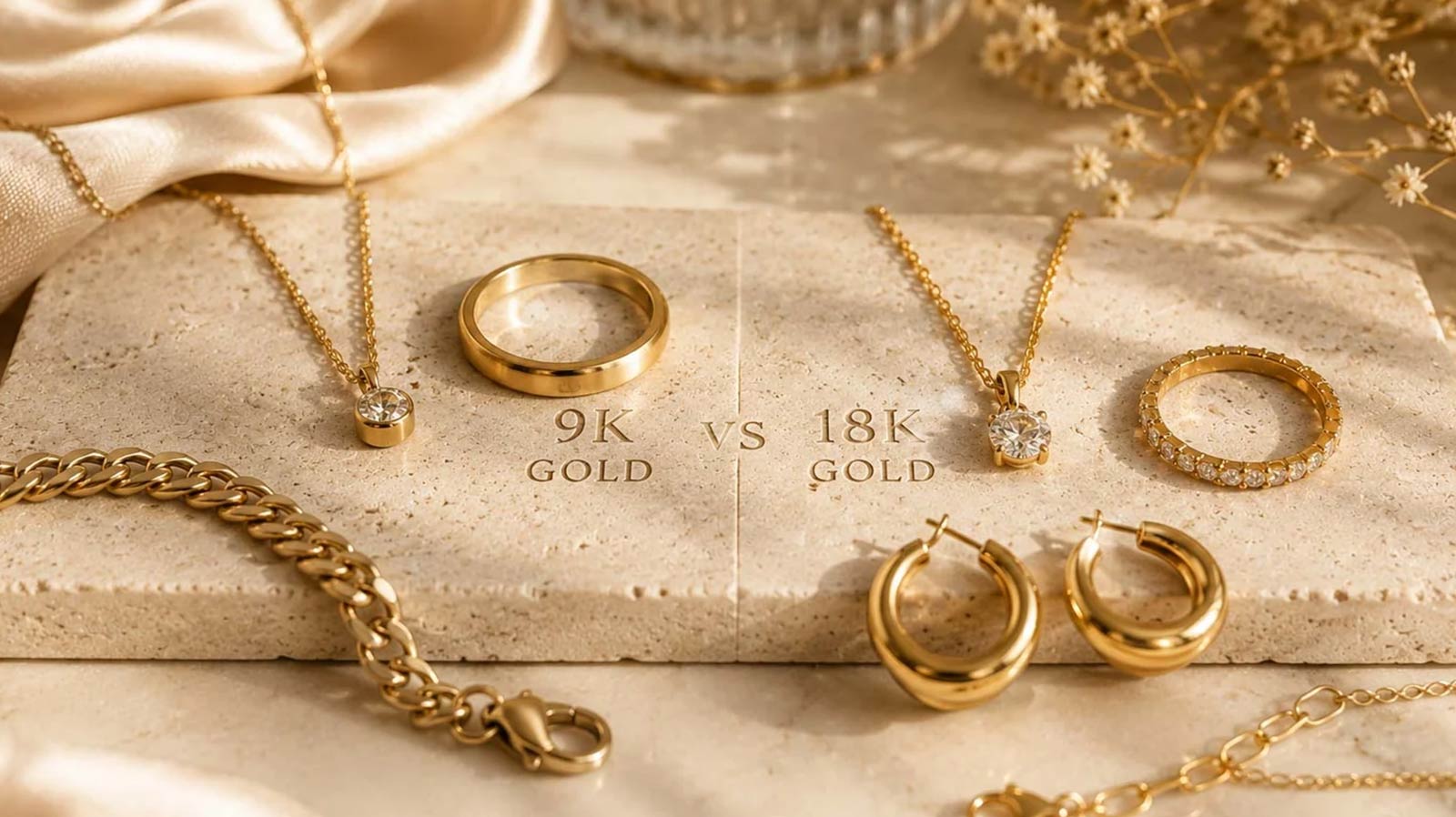
Solid gold is the same alloy throughout, so it never wears through. 9K contains 37.5% gold, is hard-wearing and keeps solid gold affordable. 14K, at 58.5% gold, deepens the colour and balances durability with richness; the comparison is covered in Juvetti's guide to 9K vs 14K gold. 18K, at 75% gold, gives the richest colour and the most precious-metal content at the highest price; the trade-offs are set out in the guide to 14K vs 18K gold. No purity is universally best: alloy behaviour depends on composition and use, so choose by budget, colour preference and how hard your jewellery lives.
UK law requires most solid gold items above one gram to carry an independent Assay Office hallmark confirming purity, and Juvetti hallmarks UK orders accordingly: a quiet but real reassurance when buying online.
How Much Does a Purple Sapphire Necklace Cost in the UK?
The prices below come from Juvetti's UK storefront, checked at the time of writing, and are best read as a guide to structure rather than a fixed catalogue.
Entry level, roughly £220 to £420. Gold vermeil versions of most pendants: a compact round halo from £220, solitaires around £250, pear drops around £370, flower designs around £400 to £420. You get the full lab-grown sapphire; the saving is in the metal.
Core solid gold, roughly £380 to £1,000. The same designs in 9K or 14K: a 9K halo pendant from about £380, a 14K oval solitaire around £660, a 14K emerald-cut statement pendant around £1,000.
Premium solid gold, roughly £650 to £1,400. 18K versions, from about £650 for a compact halo to about £1,360 for the 4 carat emerald-cut design.
Statement and tennis, from £1,380 upwards. A full tennis necklace starts at £1,380 in vermeil and runs to several thousand pounds in solid gold, where the metal weight of a whole necklace and dozens of matched, individually set stones compound.
Within any tier, price moves with stone dimensions, the number of sapphires, diamond accents, gold purity and weight, and setting complexity, never carat weight alone. The most efficient way to see these relationships is to compare purple sapphire necklaces side by side with the metal filter applied.
Natural purple sapphire pricing is far less predictable: colour, tone, treatment, origin and certification move values across an enormous range, so compare like with like and insist on a full lab report before weighing a natural stone against a lab-grown equivalent.
How to Judge a Purple Sapphire Necklace Online
A strong online listing should provide enough information to make a confident initial assessment. Confirm the following before ordering:
- Origin stated plainly: lab-grown or natural, with any treatments disclosed.
- Stone dimensions in millimetres, not carat weight alone, and whether the quoted carat figure refers to one gemstone or the total gemstone weight.
- Metal specified precisely: vermeil or solid gold, and the purity.
- Setting type and prong security visible in close-up images.
- Clasp type and chain thickness in sensible proportion to the pendant's weight.
- Whether the pendant is fixed or slides freely, and whether it can be removed from the chain.
- Photographs in more than one light, ideally with video and genuinely worn images against skin, not only isolated studio shots.
- Pendant dimensions and chain length, so you can map the scale on your own neckline.
- Returns, warranty and hallmarking: Juvetti, for reference, offers 30-day returns, a 1-year warranty with lifetime service, and UK hallmarking on solid gold orders.
Chain Length and Wearability
Most pendants ship on an adjustable 16 to 18 inch chain, placing the stone at or just below the collarbone hollow, the most versatile position for necklines and layering; longer lengths are usually available on request. Check that the pendant moves freely on the chain. Treat sapphire's durability sensibly too: corundum measures 9 on the Mohs scale and resists scratching superbly, but a hard knock can still chip any gemstone, and the chain and clasp always need more routine attention than the stone. Remove the necklace for sport and swimming, and clean it with warm soapy water and a soft brush.
Purple Sapphire Necklace Buying Checklist
- The shade still pleases you in daylight, warm indoor light and photographs.
- The stone is lively face-up, with no obvious window or large dark zones.
- It looks eye-clean at normal wearing distance.
- Origin is disclosed: lab-grown, or natural with treatments stated.
- Face-up millimetre dimensions are listed and match your expectations.
- Metal and purity are specified, with a hallmark on UK solid gold.
- The metal colour suits both the stone's undertone and your daily jewellery.
- The setting, clasp and chain thickness look secure and proportionate in close-up images.
- Chain length and adjustability fit your necklines.
- Returns, warranty and aftercare terms are clear before you pay.
Frequently Asked Questions
Are purple sapphires real sapphires? Yes. Sapphire is the mineral corundum, which occurs naturally in almost every colour. Blue is simply the most familiar; purple, violet and lavender stones are equally genuine sapphire.
Is a lab-grown purple sapphire a real sapphire? Yes. A lab-grown sapphire is corundum with essentially the same chemical, physical and optical properties as a mined stone; the difference is origin, not identity. It is not a simulant such as cubic zirconia, which merely imitates the look.
What is the best shade of purple sapphire? There is no single best. Medium violet-purple with strong saturation is the most versatile option, particularly when buying for someone else; lavender suits subtle everyday wear and deep purple suits statement pieces.
Are purple sapphire necklaces suitable for everyday wear? Yes, with ordinary care. At 9 on the Mohs scale, sapphire is harder than almost anything it will meet day to day, and pendants take far less impact than rings. Remove the necklace for sport, and have the chain and settings checked periodically.
Is yellow or white gold better for a purple sapphire? Neither is better; they do different jobs. Yellow gold adds warm contrast and makes purple look deeper, while white gold gives a cool frame that flatters blue-violet stones and merges with diamond halos. Choose the metal you already wear most.
How much should a purple sapphire necklace cost in the UK? At the time of writing, lab-grown purple sapphire pendants run from around £220 in gold vermeil to around £1,400 in 18K gold, with tennis necklaces from £1,380 to several thousand pounds. Natural sapphire pricing varies too widely for a useful headline figure.
Final Thoughts
A purple sapphire necklace rewards a methodical buyer. Settle the shade first, insist on a lively cut and an eye-clean stone, choose the metal and purity that match your life, and let disclosed origin and clear specifications carry the decision. When you are ready to compare real options, explore the full necklace collection with your shortlist of shade, style and metal in hand.