Gold Jewellery Price Explained: What You're Really Paying For
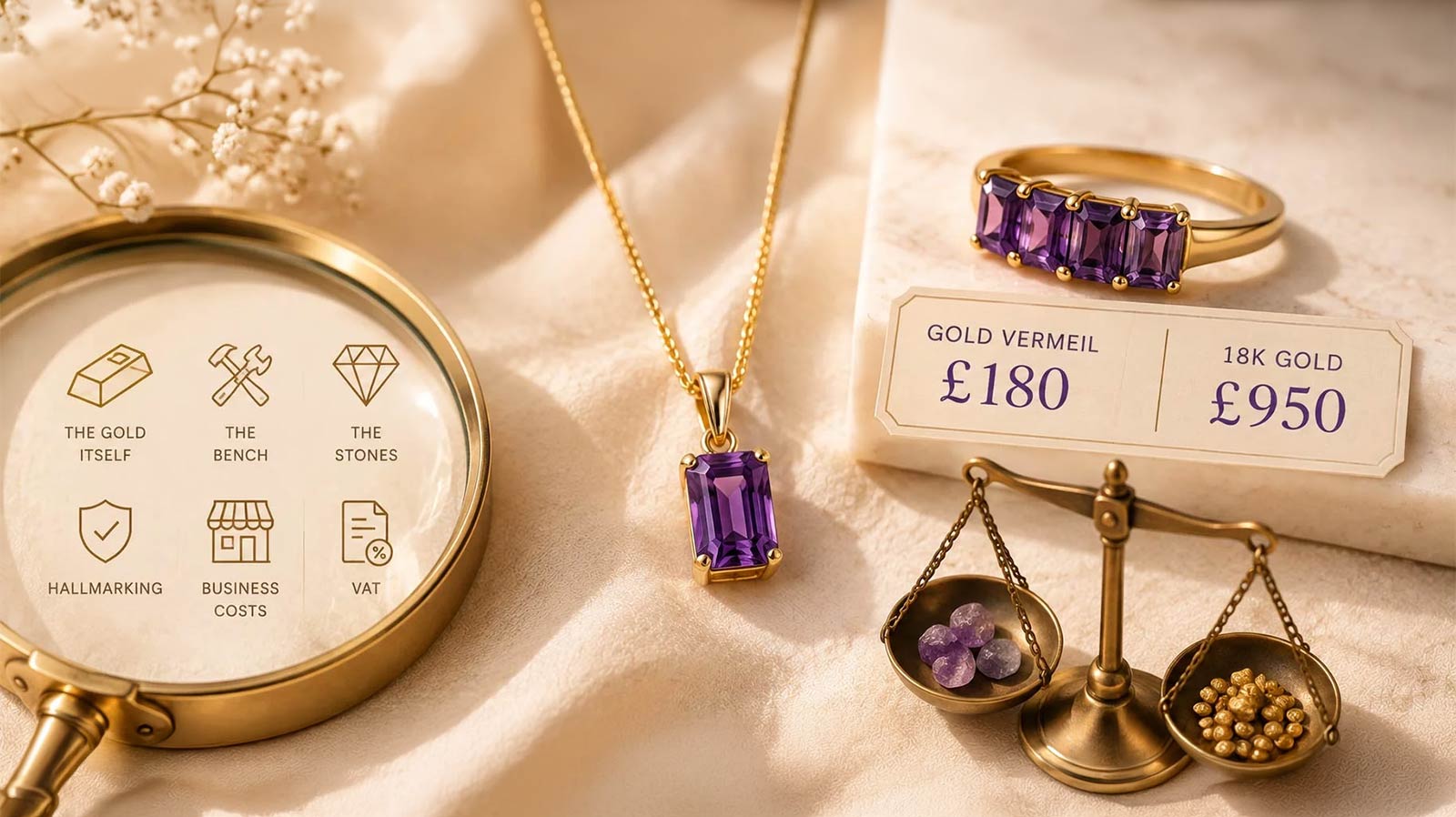
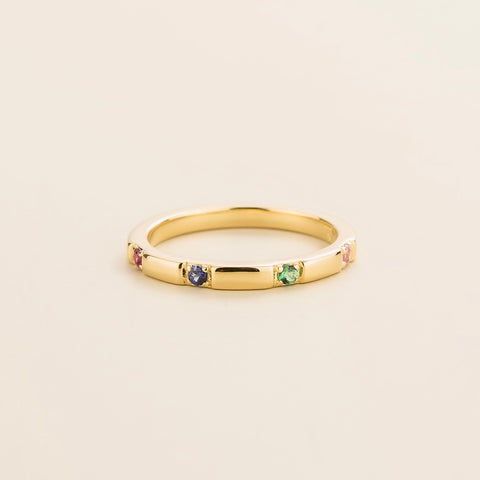
The same ring, the same four stones, the same design, offered in two of its four materials: £180 in Gold Vermeil and £950 in 18K Gold. The design and the stone arrangement are identical. What changes is the material, and it changes by more than a grade, because at £180 the piece is gold plated onto silver rather than solid gold.
Which leaves the question you probably arrived with: how much of this price is actually gold?
It is not printed on the tag, but it can be worked out from two facts about the piece and one public page anyone can open. Gold jewellery is usually bought for a reason worth remembering, and understanding the price is part of enjoying the piece rather than a chore in front of it.
What you are actually paying for when you buy gold jewellery
Six lines sit inside a gold jewellery price, and only the first of them is gold.
- The gold itself. The weight of the article, the proportion of it that is fine gold, and what the metal cost on the day the maker bought it.
- The bench. The design, the making and the setting: everything a person does to turn metal and stones into something wearable.
- The stones. What is set into the piece, and what those stones actually are.
- Hallmarking. Independent testing the law requires before an article can be sold as gold, rather than an optional extra.
- What the business has to cover. Premises, people, stock, returns, aftercare and everything else between the bench and the buyer.
- VAT. Charged on the sale as on any other retail good, and quoted inside the shelf price you see.
Design sits inside the bench line here, though another maker may account for it separately.
The metal: weight, fineness and a price that is reset twice a day
The metal line is arithmetic with three terms: the finished weight of the article, multiplied by the proportion of that weight which is fine gold, multiplied by the gold price when the maker bought the metal. The rest of the alloy does not carry the gold price.
That third term moves while you are reading. The LBMA Gold Price is set twice daily, at 10:30 and 15:00 UK time and administered independently by ICE Benchmark Administration, so a shelf price held steady for a season absorbs every movement in between and will not track a headline gold figure day for day.
So ask the seller for two things: the finished weight in grams, and the fineness in carat and in parts per thousand. A good jeweller should be happy to give you both, and the rest you can do yourself.
- Find the fine gold. Multiply the weight in grams by the fineness proportion, an 18 carat piece by 750 thousandths.
- Read a current figure. The Royal Mint publishes a gold price on its public gold price page in pounds per troy ounce, updated every 30 seconds and readable with no account or licence.
- Make the units agree. One troy ounce is 31.103 476 8 grams under Schedule 1 of the Weights and Measures Act 1985, so divide by 31.1 for a figure per gram.
- Multiply. Grams of fine gold times that per gram figure gives the metal content at today's market figure. Then do the same for the second piece.
The Royal Mint notes the caveat on its own page: those bullion prices are the live spot prices with a premium added, so the charted figure is the market price for the metal rather than a price anyone sells at. A jeweller's price sits above it, and the sections below are that gap.
What 9, 14, 18 and 22 carat mean in parts per thousand
Carat is a proportion, and the minimum fineness standards set in UK law put a figure on it in thousandths: 375 for 9 carat, 585 for 14 carat, 750 for 18 carat and 916.6 for 22 carat. So 9 carat is 37.5 percent fine gold and 18 carat is 75 percent, which gives the line behind most of the ladder below: 18 carat carries twice the fine gold of 9 carat, weight for weight.
Choosing between two carats is really a question about wear and daily life, and how 9K and 14K compare answers it properly.
Why two pieces of the same carat can cost very different amounts
At a fixed fineness, the only thing left to move the metal line is mass, and mass is a design decision. It hides in four places: the width and depth of the band, whether a chain or hoop is solid or hollow, whether an eternity band runs full or half, and how much metal sits in the shank and gallery under the stones. That last one a photograph taken from above almost never shows.
Colour is not one of them: the standards measure the gold in the alloy and nothing else, so an 18 carat piece is 750 thousandths whether it is white, yellow or rose. The differences between white, yellow and rose gold have their own page.
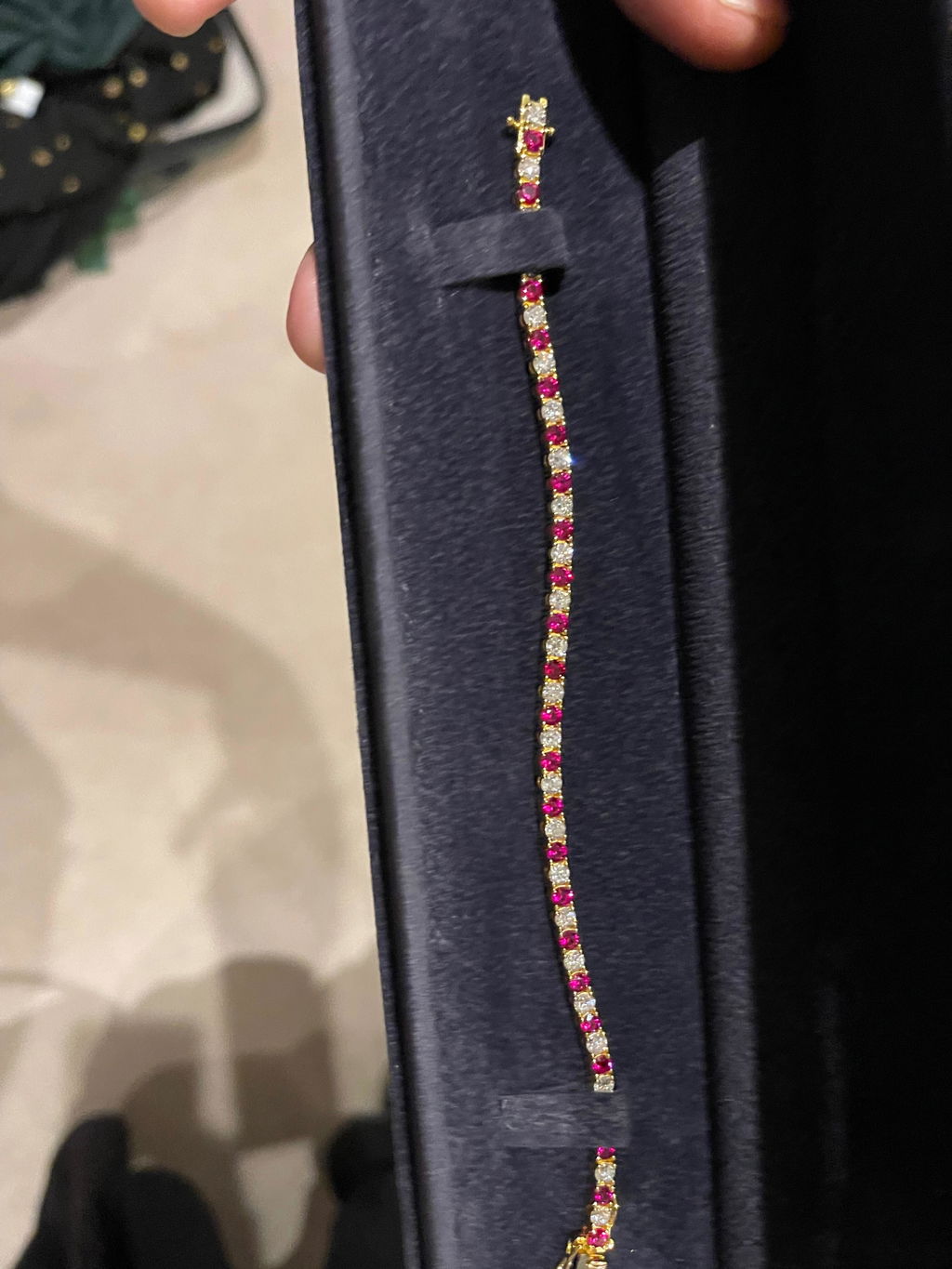
Gold bracelets make the same point on a larger scale, because a bracelet is a continuous length of metal carrying one setting after another.
One ring, four materials: what the material decision actually costs
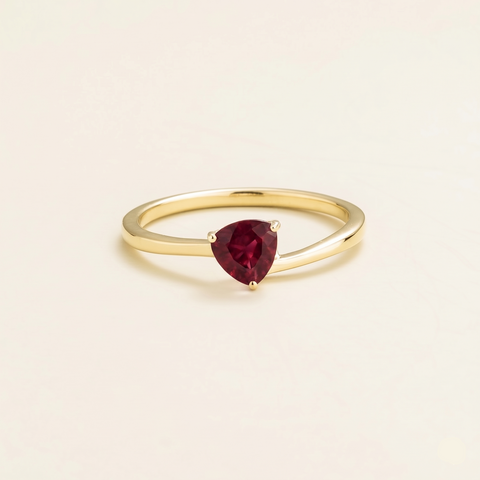
The Balans ring in ruby, blue sapphire, emerald and pink sapphire is published at £180 in Gold Vermeil, £460 in 9K Gold, £710 in 14K Gold and £950 in 18K Gold. It makes the difference easy to see, because the same design in the same stone arrangement is offered in all four materials, so the £770 spread is the material decision.
Inside that spread sit two kinds of change. From 460 to 710 to 950 is one construction at three fineness standards, so fineness is all that moves. The bottom rung differs in kind, because Gold Vermeil is a gold layer over a silver article, as the sub-section below explains.
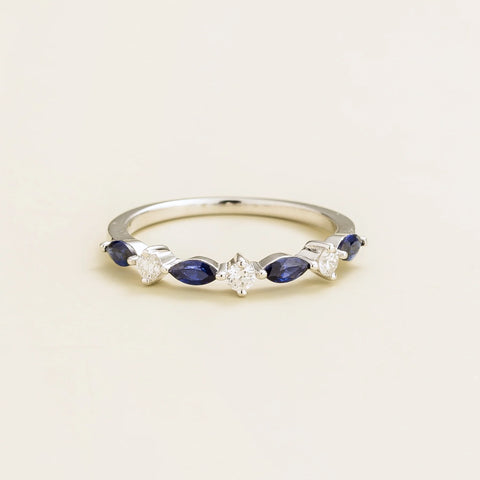
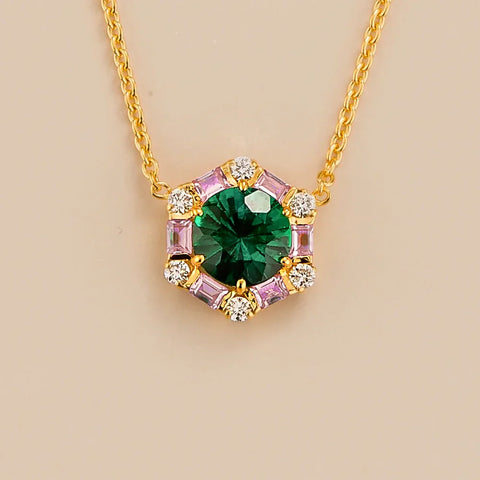
Which is where the step that surprises people comes from. The largest single jump is not 14K to 18K. It is the step out of Gold Vermeil, and each step after it is smaller than the one before. You can check the shape on the three pieces we compared, at three different starting prices: this Balans station band ring, the Marquise half eternity band and the Melba halo pendant. The vermeil step was the largest every time, in proportion as well as in pounds. That describes how Juvetti prices its own ladder rather than the UK market as a whole.
On this ring the price is identical across every size, including Custom, so size is not what separates the four figures. Other sellers handle it differently, so it is worth asking. The ring collection is the place to compare the four, and which option gives the best value for money takes up the question this page leaves open.
Where gold vermeil sits, and why it is a different object
Vermeil is a gold layer over a silver article. UK guidance on gold plated silver articles allows "vermeil" to be used in addition to a "gold plated" description, and states the gold layer must be at least 375 parts per thousand fine and should not exceed 2 microns thick. Note which way round those work: 375 is a floor on fineness, while 2 microns is a ceiling on thickness rather than a floor, and no UK institutional source located for this article sets a minimum. The 2.5 micron figure you may have met online is the United States standard at 16 CFR 23.4(b), with no force in British law.
The hallmarking consequence is easy to get backwards. A gold plated silver article is hallmarked as silver, never as gold, however thick the plating, and below the 7.78 gram silver exemption weight it needs no mark at all. What a vermeil piece skips is the gold assay step. Gold plated base metal, including bonded and rolled gold, cannot be hallmarked at all, so if a listing says gold plated without saying what sits underneath, ask what the base metal is.
Why should a change of material move a price further than a change of carat does? As a jeweller's reading of figures you can check yourself: vermeil to 9K is a change of kind, from a silver article carrying a gold layer to a solid gold one, while 9K to 14K to 18K are changes of degree within one material.
The bench: what the making charge actually pays for
What a jeweller quotes as a making charge is the line this page calls the bench: the hours a person spends on the piece, costed as time rather than as a share of anything else.
Trade guidance on pricing puts the method plainly: establish an hourly rate by dividing total earnings plus overheads by the hours you intend to work in a year, then apply it to the time a piece takes. Labour is time multiplied by a rate. That explains the part of a quote with nothing to do with metal: a piece made after the order is placed carries its own hours in full, because there is no production run to spread them across.
What fills those hours on a hand-made stone-set piece, in general terms rather than any one workshop's sequence: forming and sizing the band, filing and soldering, cutting a seat for each stone, closing the claws or bezel one at a time, then finishing and polishing. Each Juvetti piece is individually handcrafted by skilled craftsmen, and the hours are where a piece gets the quiet precision you feel when you put it on. A stone set by hand takes bench time, so a piece carrying twelve takes more than one carrying a single stone, though that is a jeweller's judgement rather than a formula.
The rate covers the conditions the work is done in as well. Juvetti's workshops are certified by the Responsible Jewellery Council for safe working conditions, fair employee rights and responsible corporate governance, and conditions of that standard sit inside the hourly rate rather than beside it.
We do not publish an hourly rate, because ours would describe one workshop rather than the quote in your hand. Two questions get you further: is the piece made to order or held in stock, and are the stones set by hand or pre-set in a bought-in mount?
The stones: what you are paying for, and what you are not
Two things are charged here, not one: the stones themselves, and the bench hours each takes to set. A halo or cluster adds to both at once, because every small stone in the surround is stone content and each needs its own seat and claws.
Then the distinction that decides what you are actually buying. Lab-cultured gemstones share the same chemical structure, optical properties and physical features as mined stones, and they are not simulants. Cubic zirconia and nano crystals are different materials altogether, so they may differ from a cultivated gemstone in optical properties, in hardness and durability, and in how they are cared for. Neither is a fault; they are simply not the same thing, and the price should tell you which you have.
The easiest way to compare two pieces is to ask three short questions. What is the species? Is it cultured or mined? Is it a gemstone or a simulant? A listing that says gemstone, crystal or stone has not named a species, and a good jeweller should be happy to explain which of the three you are looking at. Those three answers, plus the carat weight, tell you more than any price range would.
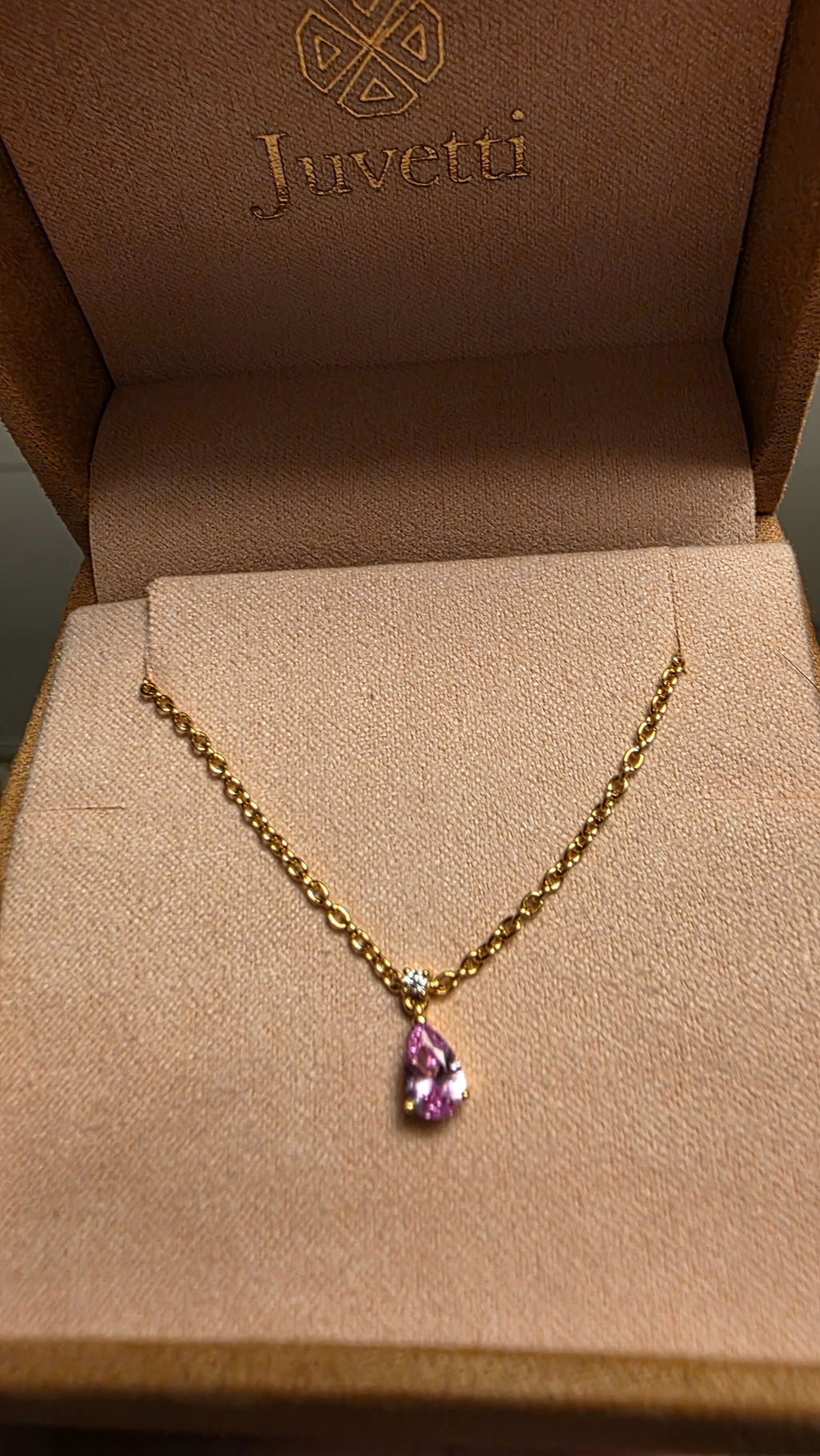
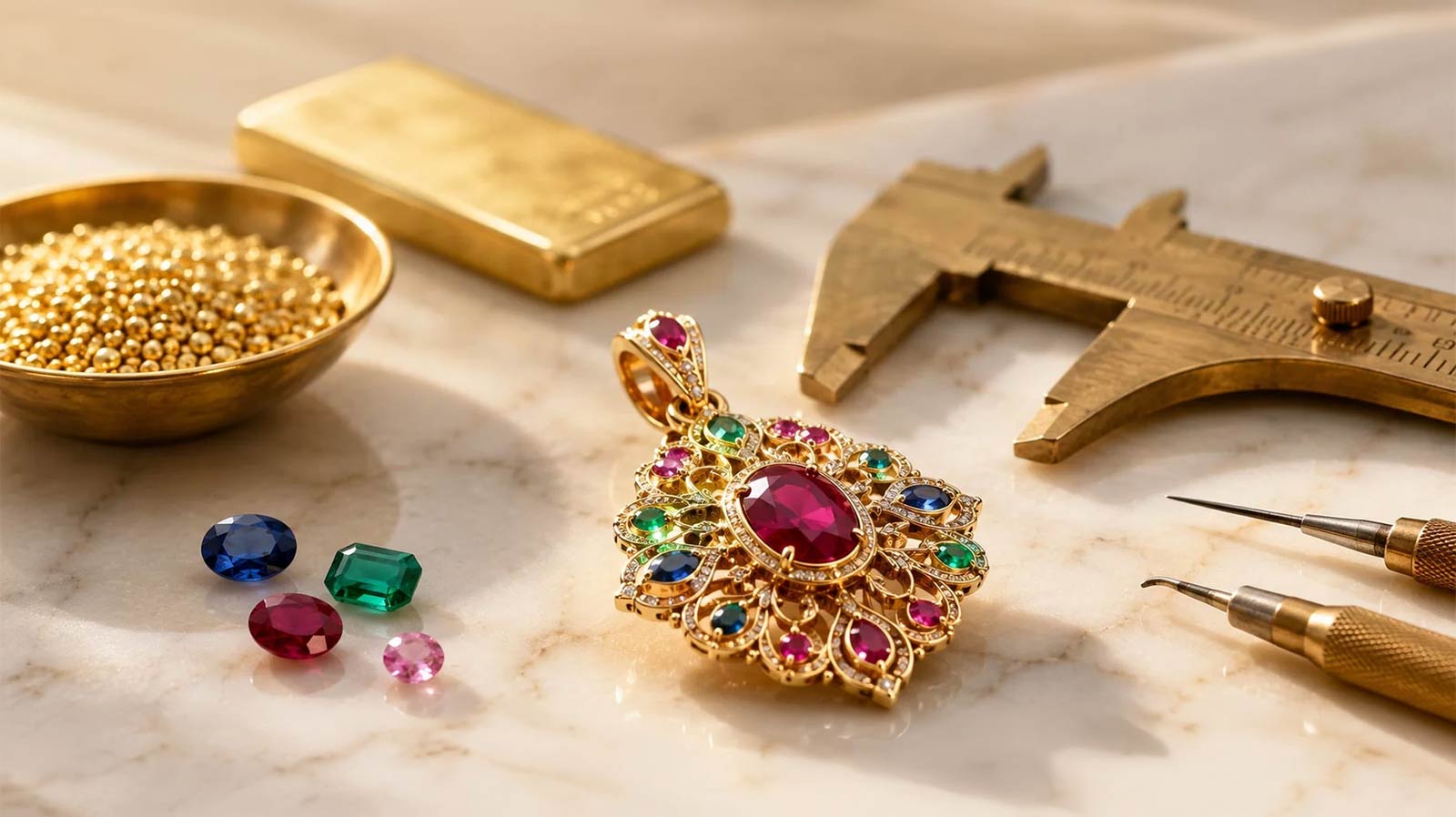
Take them to the gold pendant necklaces, where the setting half of this section becomes visible: the Melba below is a centre stone inside a halo of small stones, each seated and closed individually. Our own stones are cultivated in renewable-energy-powered laboratories rather than mined, and set into 100 percent recycled gold and silver.
Hallmarking: the line the law sets, not the maker
The maker decides the weight, the design, the stones and the finish. Hallmarking is the one line UK law sets instead. Under section 1 of the Hallmarking Act 1973 it is an offence, in a trade or business, to supply an unhallmarked article described as gold, silver, platinum or palladium, except where an exemption applies. Exemption weights are gold 1.0 gram, palladium 1.0 gram, platinum 0.5 grams and silver 7.78 grams, measured on the weight of the article, not the gold content inside a heavier piece.
So a pair of small gold studs or a fine chain can fall under the threshold and legitimately carry no mark; if you are unsure, ask which exemption applies. A gold ring above it, sold by a business, should carry a mark.
The three marks, and what each one tells you
A UK hallmark is three compulsory symbols, each answering a different question. The sponsor's mark identifies who submitted the article, the metal and fineness mark states the metal and its purity, and the assay office mark identifies the office that tested it.
The number inside the fineness mark is the thousandths figure from earlier, so 750 struck into the ring and 18 carat on the label are the same statement made twice, once by the seller and once by an independent office. That is what the mark buys you: fineness tested rather than asserted.
Where to look: inside the band of a ring, on a clasp, or on a small tag on a chain. Photograph it and enlarge the photograph, because a phone camera reads symbols struck that small better than an eye.
What hallmarking actually costs the maker
Both halves of this matter, because either alone gives the wrong impression. The Assay Office Birmingham hallmarking price list, read on 14 August 2026, charges 64 pence per gold ring and applies a minimum parcel charge of £23. The rest, before VAT: 70 pence per bangle, bracelet, chain or necklace, 51 pence per earring, and 60 pence per pendant, charm or cufflink.
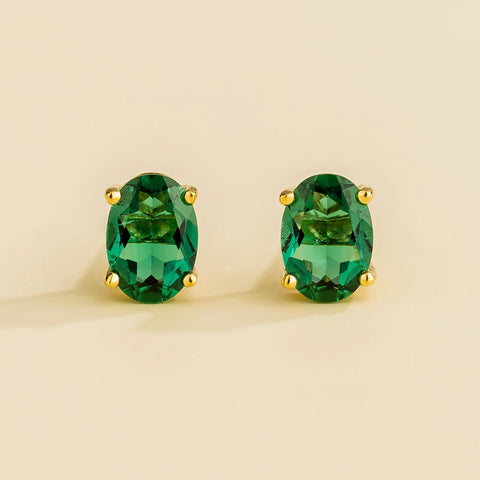
The earring line behaves differently: the charge is per earring rather than per pair, so a pair of gold earrings carries it twice, as the Ovo studs below show.
Now the arithmetic those two figures only do together. A maker sending a single ring does not pay 64 pence, they pay the 23 pound minimum. A maker sending several hundred pays 64 pence each. Same law, same office, same mark, and a far higher cost per piece for the single-piece consignment.
Set against the 180 to 950 pound range above, even a full minimum parcel charge is a small line. Hallmarking is not why fine jewellery costs what it does. The published page carries no effective date and the charges exclude carriage, insurance and extras, so treat them as an indication of scale.
What the shelf price still has to cover
Although the exact amount varies from one jeweller to the next, these are the main things a shelf price carries: premises and workshop, the people at the bench and the certified conditions they work in, stock, insurance, returns, aftercare and warranty repairs, and the packaging, photography and website behind it all. All of it comes from the same figure that pays for the gold.
We do not publish a mark-up multiple, because we know of no UK-wide figure worth quoting. The more useful question, and one you can put to any seller, is which of those lines their price includes: aftercare, resizing and warranty are the ones worth asking about.
Then the one tax figure. The standard rate of UK VAT is 20 percent, applied to the price before tax, so a VAT-inclusive shelf price is 120 percent of the net and the tax element is 20 divided by 120. That is one sixth of what you pay, roughly 16.7 percent, and not one fifth. Dividing an inclusive price by 1.2 returns the net. So, on the quote in front of you: does that figure include it?
The mirror question, how much comes back if you sell, is a different transaction with its own page: what gold jewellery is worth if you come to sell it.
Why a chain store can price the same weight lower
Three mechanisms, each already on this page. Volume spreads fixed costs, as the minimum parcel charge showed in miniature. Batch production spreads the bench hours, while a made-to-order piece carries its own in full. And a design can be drawn to use fewer grams: at the same fineness, a narrower band, a hollow hoop or a lighter gallery lowers the metal line without changing anything the hallmark reports.
So is a lower price a lesser piece? Not automatically. It is a different set of trade-offs, and the five questions below bring them into the open on any piece.
Five questions that make any gold jewellery price clear
These five take a minute, and they work on any piece from any jeweller, ourselves included.
- What does the finished piece weigh, in grams? The number that starts the metal arithmetic. If a seller prices by size, ask for the weight in your size.
- What is the fineness, in carat and in thousandths? Both together, so the figure lines up with the standards above.
- Is it hallmarked, and by which assay office? If not, which exemption applies? Either answer is fine, and a plated or vermeil piece will never carry a gold hallmark, which is worth knowing before you buy.
- What exactly are the stones, by species, and are they cultured, mined or simulants? Gemstone and crystal are descriptions rather than species, so ask for the species by name.
- Does the quoted figure include VAT? A quick yes or no saves an awkward surprise at checkout.
Five clear answers will not always point you to the cheapest piece, but they will tell you every line in the price can be named. At Juvetti, we believe you should feel confident about what you are choosing, so we are glad to answer all five on anything we make.
Start with the two questions that open all the others: what does the piece weigh in grams, and what is its fineness. With those answers, a price stops being a number you take on trust and becomes arithmetic you can follow. The rest is the pleasure of choosing: the colour of the metal, the stone you keep coming back to, the design that suits the person who will wear it.
Explore the Juvetti ring collection and compare the gold options on a design you would actually wear. If this is the first of several pieces, building a gold collection over time sets out a comfortable order to buy in. If you would like help choosing the material, our team will be happy to guide you.
Frequently Asked Questions
Does a hallmark tell me how much gold is in the piece?
No, and it is a common thing to assume. The fineness mark states purity rather than quantity: it certifies the proportion of fine gold in thousandths, and weight is a separate fact you have to ask for.
Why is the same piece a different price than when I last looked?
The benchmark behind the metal line is reset twice a day, at 10:30 and 15:00 UK time, and a maker holding a fixed shelf price absorbs the movement in between until the price is restated. A published price is a price on the day, and the product page is always the version that counts.
Is a higher carat always a higher price?
Not across different pieces. Fineness sets the proportion of fine gold and weight sets how much of it there is, so a heavy 9K piece can carry more fine gold, and cost more, than a light 18K one. The ladder above shows what carat does when the design and stone arrangement are held identical.